

Sunday, 6 April 2025

EARTHQUAKE CONDOS CLEARANCE SALE

6 April 2025

Haggling for a condo deal

Are there any property bargains to be had after the earthquake? 

Far as I can understand all these recently built condo blocks are built the same way: they just ram pillars into the ground and run some beams across and then they fill in the gaps with block work and render over to keep the partitions all together and then a coat of plaster to give a smooth surface over which to paint. 

They're carrying out structural inspections, but all the structures are probably fine, it's just that the swaying shook off some of the render. 

The affected blocks lie within one, two or maybe more thousand kilometers of Mandalay. 

I would imagine the earthquake has put off a lot of potential buyers. And added to that there's been the crash in the stock market and we're heading into a global recession with further baht weakness as a result. So I should think amidst all this uncertainty and the click bait news in the mainstream media, there's going to be a drop off in demand. 

I'd also imagine that there'll be a build-up of cheaper properties coming onto the market and for the less well off sellers who have to sell, they will be obliged to reduce their price. But for more expensive condos owned by wealthier people, they will have other options if they need a bit of liquidity and these people would not be inclined to panic and reduce their price. 

So my guess would be that now would be a good time to negotiate lower prices on cheaper properties and the kind of people who'd be interested are people who want to move but also landlords. 

Bearing in mind that the condos are probably perfectly okay and just need a couple hundred US dollars spent on pasting over the cracks, I agree with you that there probably are some real bargains, especially by forced sellers. 

How long will this situation endure? I'd imagine until the end of the coming recession (not connected to the earthquake incidentally), so let's say a year or two. Classically, recession is the best time to buy a property and the worst time to sell. 

So let's try and quantify that: you could get an additional 5% off high-end property, 10% off mid-range and 15% off lower priced properties.

Plus a further discount when you transfer money into an already depreciating currency, made worse by the new tariffs. 


So in conclusion yes, as recession follows earthquake, now and in the short term is probably a good time to buy a property in Bangkok. 

====+


>  I just saw an article in the Bangkok times Facebook page which said that lots of lots of properties in Bangkok now got cracks inside and of course one of the comments was now is probably a good time to buy Bangkok properties.
>  
>  
>  
> I’m not entirely sure of this but I haven’t got money at the moment but what do you think of that idea ?
>  
>  
>  

Friday, 4 April 2025

MAGANOMICS - PREMIUM AND PULLBACK

4 April 2025

What's premium for the US economy is pullback for the investor.... We knew it was coming - here's Joseph Wang on March 31, 2025:

"Revenue Side

The Administration's overall revenue goals suggest that Liberation Day will unveil tariffs that are both large and persistent. Officials have guided towards a goal of a reducing the fiscal deficit from 6% to 3%, which implies a $2t deficit reduction. Recent communication suggests half of this amount will come from austerity, and the balance from higher revenue. Secretary Lutnick has proposed golden visas, tax reform, and tariff revenue as the three primary mechanisms to raise $1t a year. This suggests that the heavy lifting will have to come from tariffs, which would also be in line with many sizable sector tariffs recently announced. This post walks through the revenue raising plan and suggests the market is still not fully prepared for the structural shifts planned by the Administration."

For a long term saver, such as someone in their 30s, saving for some medium term projects, but basically investing for retirement, they just keep on ploughing in their monthly amount (but don't put your lottery winnings in just at the moment!), and no need to be disturbed by this downturn.

For someone in retirement, it's not quite the same picture. Capital preservation is the order of the day, because this determines what can be withdrawn over the medium term (the 4% rule).

The surprise for most people in this latest pullback was how the dollar devalued by almost 2% whilst Trump was talking.


This is a bit of a fork in the road because maganomics calls for a weaker dollar, but the dollar milkshake theory (which I will finish off writing about...) says the dollar will go higher ...until the final reckoning in a few years out of course, when the US dollar loses its reserve status.

It is simply not possible to call market highs and lows, but if you go back to 12 Feb - see my blog post of the 12 Feb "this is behind my feeling that markets have topped" - then there's been a 12% pullback ... with another 20 to 30 percent to come... who knows? Keep in mind that the US market is still well over valued. For an exceptional example, Tesla is on a P/E of 100.

The least that can be said is that we are risk off while Trump is fixing the economy ie implementing his maganomics strategies. 

Think like a businessman. Trump is a pretty versatile character, but at base he is a businessman. 
 
          Kaplan and Norton
     "The Execution Premium"

The balance sheet, the P&L and cash flow are king, big ideas and clever strategies are fine, but success is all in the execution. Ie how you turn strategies into programs of work and roll them out into operations.

What is premium for the US economy is pullback for us. "Short term pain."

Thursday, 3 April 2025

MAGAnomics

3 April 2025


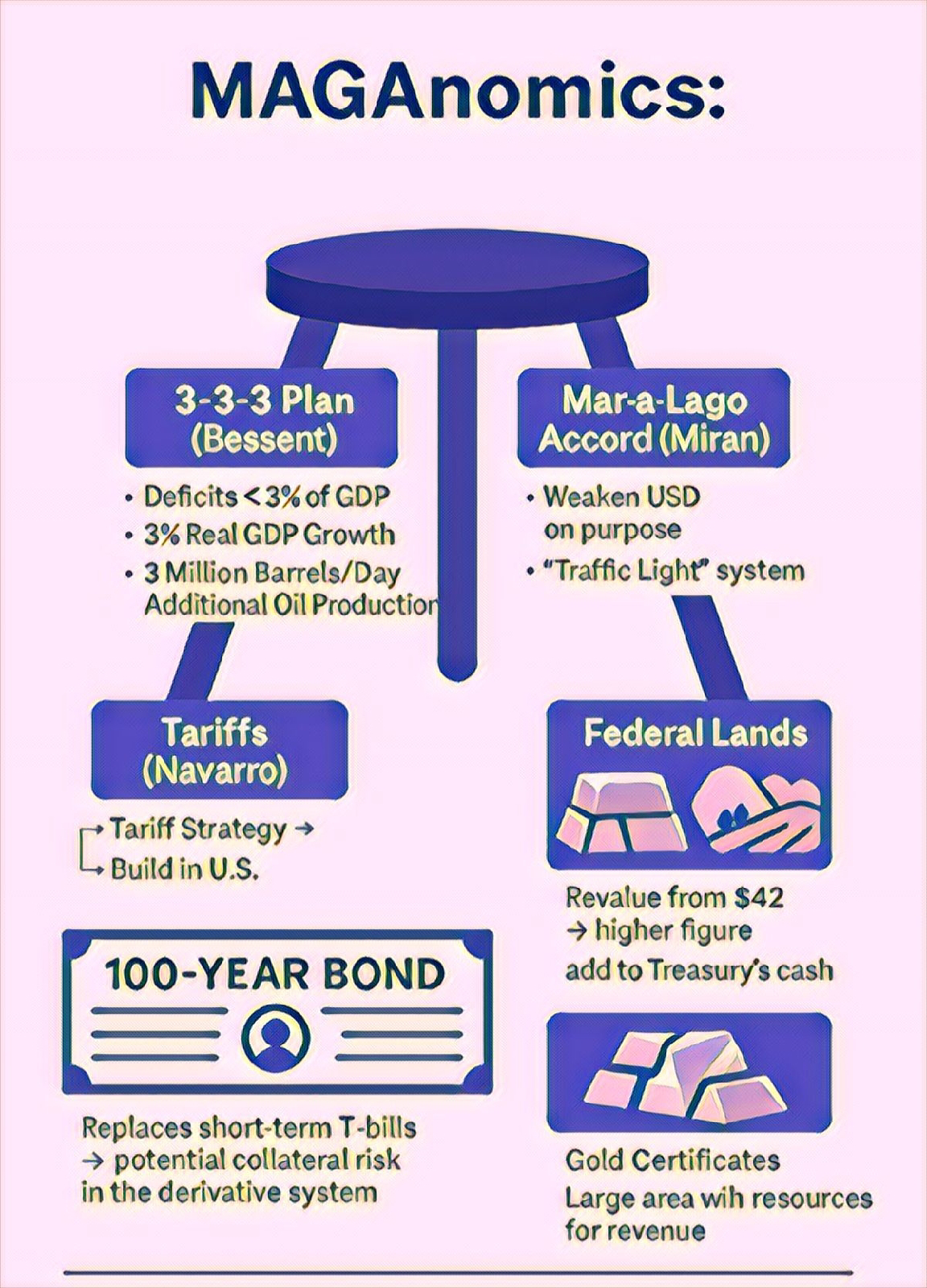
Trump’s signature principles can be seen as a “three-legged stool".

Leg One: The 3-3-3 Plan
Sometimes called the “three arrows,” championed by Treasury Secretary Bessent and staff early on. The idea: keep deficits below 3% of GDP, achieve real GDP growth of 3%, and add about 3 million barrels per day of domestic oil production (or some big chunk of increased energy output). 

If you keep deficits under 3% and achieve 3% real growth (plus maybe 2% inflation = 5% nominal), the debt-to-GDP ratio goes down - and that's what counts. You don’t have to pay the debt off—just roll it over. As long as GDP keeps on growing faster than the debt, the ratio declines, which maintains sustainability and thus confidence. 

The 3 million extra barrels of oil help keep energy prices down, contributing to growth and taming inflation.

Leg Two: Navarro’s Tariff Strategy
Peter Navarro is all about tariffs and reindustrialisation. The mainstream view says tariffs are inflationary, like a sales tax on Americans. However, the reality is that with consumers tapped out, foreign producers often eat the tariff cost. That can be deflationary since it compresses producers’ margins. It pushes foreign companies to relocate factories to the States to avoid tariffs, creating U.S. jobs. Historically, the U.S. relied on tariffs from 1790 to 1962—what’s called “The American System". Income tax is a relatively recent thing. So this is actually a return to older policies. Contrary to the notion that tariffs are a consumer tax, the cost typically isn’t passed to American buyers if they can’t pay higher prices. Instead, foreign producers absorb it.

Leg Three: Miran’s “Mar-a-Lago Accord”
Rickards coined that term in 2019 in his book Aftermath, see Chapter 6. 

Stephen Miran is an adviser who wrote a key paper about the U.S. seeking a weaker dollar, reminiscent of the Plaza Accord in 1985. He argues that if foreigners try to offset U.S. tariffs by devaluing their currencies, the U.S. should intentionally weaken the dollar, not lose its reserve status, but orchestrate the devaluation. 

That’s reminiscent of Nixon in 1971 and the Saudi agreement of 1974, and James Baker in 1985—both times the U.S. government, the Treasury Department, acting under direction from the President (and sometimes in coordination with the Federal Reserve) devalued the dollar heavily yet kept the reserve currency because of other geopolitical deals (like as we said the petrodollar in ‘74, or the official G5 deals in ‘85).

 In addition

Miran also floated a plan to swap short-term Treasury bills for century bonds. These are 100-year zero-coupon or steep discount bonds. No coupon, you buy at a maybe 40% or 60% discount and in a hundred years your money is yours again.. 

This would ease the government’s immediate financing cost, but it could be a time bomb for the global collateral system because short-term T-bills act as key collateral in the 1000 trillion dollar derivatives markets. If you replace them with illiquid long-term bonds, you risk blowing up the derivatives market. That’s the bit that is most worrying in this whole maganomics

In addition, Miran suggested revaluing the Treasury’s gold certificates from $42 to something like the current price, $3,100 an ounce, adding eight hundred billion to the TGA Treasury General Account, without any new debt. 

Turning to the assets side of the balance sheet (think like a businessman!), also monetising the enormous state lands - selling or leasing vast federal lands to monetise resources.

And we haven't talked about deregulation and we haven't talked about golden visas for high talent high net worth individuals and a host of other deals to kickstart the economy, 

It’s a big, multi-step plan to reduce deficits, raise growth, reindustrialise via tariffs, cheapen the dollar... but with potential pitfalls if executed poorly (especially the T-bill swap).

Wednesday, 2 April 2025

SANLUCAR

Tuesday, 1 April 2025

IS AI RUNNING GOVERNMENT

1 April 2025

"Five Government departments are using artificial intelligence to answer questions in Parliament.

Labour ministers were accused of providing "stock answers generated by a computer" when responding to questions tabled by their fellow MPs.

It comes after it emerged that Peter Kyle, the Science Secretary, has used AI software ChatGPT to help him come up with policy advice.

All departments were asked last month by Tory backbencher Peter Bedford whether they were using AI to respond to MPs' parliamentary written questions.

The Department for Business and Trade, the Department for Education, the Department for Work and Pensions, the Department for Science, Innovation and Technology and the Foreign Office all confirmed that they were."

          The Daily Telegraph reveals

This is a good thing because it speeds up the required research, it formats intermediate output in a way that is easy to follow - use of headings and bullet points etcetera - and it helps write quickly in a convincing, but also standard style.

Would someone critical of this use of Al also recommend that the prime minister travel to work by horse-drawn carriage rather than EV?

With the right series of prompts, AI will format output that can be checked and then  fed back in to write a suitably nuanced answer in a style suitable for the houses of parliament.

For a writer it's  most helpful., it helps collect and analyse and organise and support thoughts into a broad and balanced comprehensive perspective of the writer's choosing. This output can b returned for help in communicating an interesting output.

So far so good for PMQs ?

Well, good for the writer, looking for a speedy, comprehensive and stylish text. But the writer is not making policy!


The RASCI framework is widely used in organisations for deciding the roles of participants in a project. 

If you "think RASCI", it's a way for assigning responsibility in a project team, you can immediately see that the minister answering questions is accountable to parliament for government policy, but is not responsible. Accountable but not Responsible. You could say that his Support team and simply Informs him of what he must Communicate.

Shock horror?

Not really because it's always been that way. All that's happening is AI is helping the team of civil servants produce standard answers more quickly. If the minister's team is responsible for the content, then presumably they Validate and Improve the AI output, before giving the minister their "lines", and the minister Verifies before delivering to parliament.

The risk is the same everywhere, which is that with this massive and powerful support, we become lazy and uncritical, our mental faculties decline, and without a strict error check and validation process, for the minister to sign off, then things could go very wrong. Because surprise surprise AI can make mistakes.