Friday, 4 April 2025
MAGANOMICS - PREMIUM AND PULLBACK
Thursday, 3 April 2025
MAGAnomics
3 April 2025
Trump’s signature
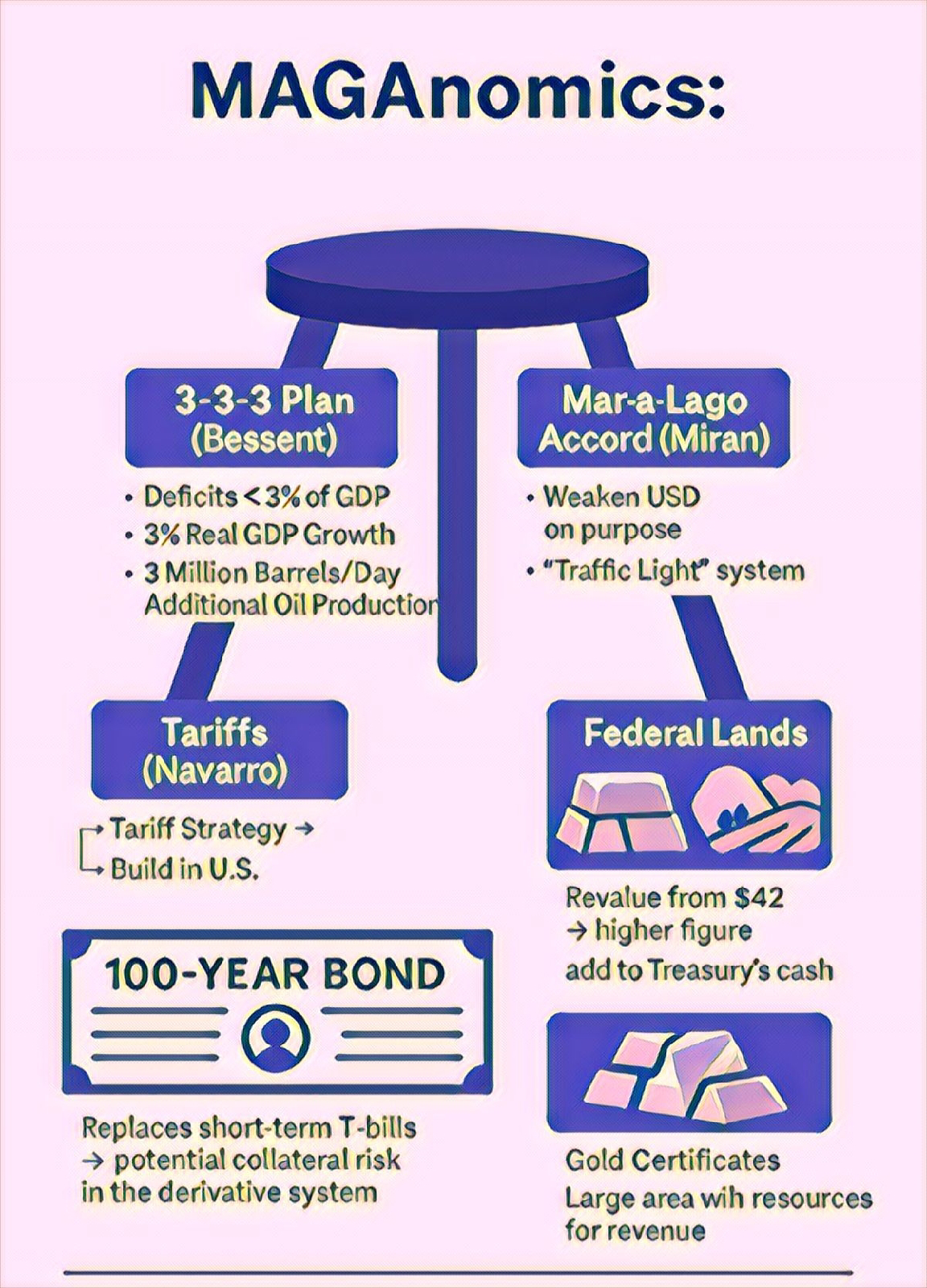
principles can be seen as a “three-legged stool".
Leg One: The 3-3-3 Plan
Sometimes called the “three arrows,” championed by Treasury Secretary Bessent and staff
early on. The idea: keep deficits below 3% of GDP, achieve real GDP growth of
3%, and add about 3 million barrels per day of domestic oil production (or some
big chunk of increased energy output).
If you keep deficits under 3% and achieve 3% real growth (plus maybe 2% inflation = 5% nominal), the debt-to-GDP ratio goes down - and that's what counts. You don’t have to pay the debt off—just roll it over. As long as GDP keeps on growing faster than the debt, the ratio declines, which maintains sustainability and thus confidence.
The 3 million extra barrels of oil help keep energy prices down, contributing to growth and taming inflation.
Leg Two: Navarro’s Tariff Strategy
Peter Navarro is all about tariffs and reindustrialisation. The mainstream view
says tariffs are inflationary, like a sales tax on Americans. However, the
reality is that with consumers tapped out, foreign producers often eat the
tariff cost. That can be deflationary since it compresses producers’ margins.
It pushes foreign companies to relocate factories to the States to avoid tariffs,
creating U.S. jobs. Historically, the U.S. relied on tariffs from 1790 to
1962—what’s called “The American System". Income tax is a relatively recent thing. So this is actually a return to older
policies. Contrary to the notion that tariffs are a consumer tax, the cost
typically isn’t passed to American buyers if they can’t pay higher prices.
Instead, foreign producers absorb it.
Leg Three: Miran’s “Mar-a-Lago Accord”
Rickards coined that term in 2019 in his book Aftermath, see Chapter 6.
Stephen Miran is an adviser who wrote a key paper about the U.S. seeking a weaker dollar, reminiscent of the Plaza Accord in 1985. He argues that if foreigners try to offset U.S. tariffs by devaluing their currencies, the U.S. should intentionally weaken the dollar, not lose its reserve status, but orchestrate the devaluation.
That’s reminiscent of Nixon in 1971 and the Saudi agreement of 1974, and James Baker in 1985—both times the U.S. government, the Treasury Department, acting under direction from the President (and sometimes in coordination with the Federal Reserve) devalued the dollar heavily yet kept the reserve currency because of other geopolitical deals (like as we said the petrodollar in ‘74, or the official G5 deals in ‘85).
In addition
Miran also floated a plan to swap short-term Treasury bills for century bonds. These are 100-year zero-coupon or steep discount bonds. No coupon, you buy at a maybe 40% or 60% discount and in a hundred years your money is yours again..
This would ease the government’s immediate financing cost, but it could be a time bomb for the global collateral system because short-term T-bills act as key collateral in the 1000 trillion dollar derivatives markets. If you replace them with illiquid long-term bonds, you risk blowing up the derivatives market. That’s the bit that is most worrying in this whole maganomics
In addition, Miran suggested revaluing the Treasury’s gold certificates from $42 to something like the current price, $3,100 an ounce, adding eight hundred billion to the TGA Treasury General Account, without any new debt.
Turning to the assets side of the balance sheet (think like a businessman!), also monetising the enormous state lands - selling or leasing vast federal lands to monetise resources.
And we haven't talked about deregulation and we haven't talked about golden visas for high talent high net worth individuals and a host of other deals to kickstart the economy,
It’s a big, multi-step plan to reduce deficits, raise growth, reindustrialise via tariffs, cheapen the dollar... but with potential pitfalls if executed poorly (especially the T-bill swap).
Wednesday, 2 April 2025
Tuesday, 1 April 2025
IS AI RUNNING GOVERNMENT
Sunday, 30 March 2025
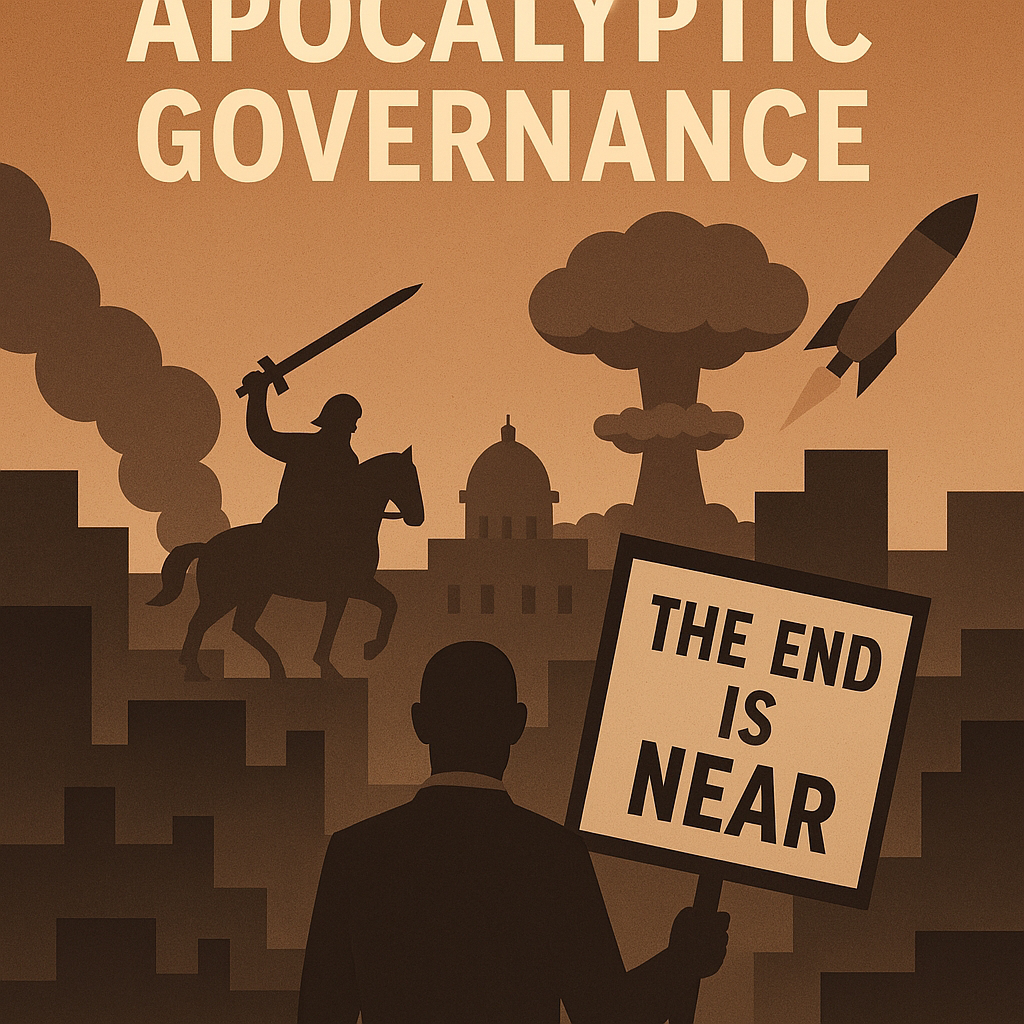
THE DANGER OF APOCALYPTIC GOVERNANCE
FROM EARTHQUAKE TO ARMAGEDDON, HOW APOCALYPTIAN THINKING SHAPES THE MODERN WORLD AND WHAT TO DO ABOUT IT
From Earthquake to Armageddon: How Apocalyptic Thinking Shapes the Modern World And What To Do About It.
"We can learn from cultures that saw time as a circle, not a line. From leaders who act more like gardeners than generals. From systems that focus on repair, not wrath."
Two days ago, an earthquake shook Northern Thailand. It came not as an isolated event, but as the third in a series of natural shocks: flooding in late 2024, annual pollution past dry season, and now earthquake.
On its own, each disaster could be seen as unfortunate, perhaps a quirk of nature. But taken together, they point to something larger, something many people feel in their bones: that we are living in a time of cascading crises, even End Times.
The hope of this article is that by understanding the apocalypse mentality, we can avoid slamming into Armageddon.
Chapter 1: Local Shocks in Southeast Asia
Northern Thailand and its neighbours have endured a string of environmental hits:
- Floods rivers that overflowed into streets and submerged fields and villages
- Pollution from crop burning and a haze from cleaning up forests.
- And now a 7.7 magnitude earthquake with tremors felt across the region
These disasters no longer feel rare or isolated. In places like Southeast Asia, they’re becoming seasonal, cyclical, even expected. And in some ways they are accelerating.
Chapter 2: Global Fault Lines
Beyond the local environment, tectonic pressures are building globally. Globally, there are worrying signs of more disasters to come:
- Public Debt Pile: Sovereign debts are ballooning. When the bill comes due, austerity bites, stability crumbles, the economy could enter recession ( this is not financial advice, but sell out to cas and gold, Monday) and people will take to the streets.
- Trade Wars: Globalisation is fraying. Tariffs and sanctions and the US dollar are the new weapons.
- Hot Wars and Security Flashpoints: From Ukraine to Gaza to the South China Sea, conflict is turning conventional again.
- Climate Change: The slow-burning catastrophe that underpins them all. Droughts, fires, floods, and forced migrations.
Each of these is a crisis in itself. But together, they are forming a perfect storm. And in that storm, old narratives begin to resurface.
Chapter 3: Apocalyptic Thinking is in Power
The world’s three great apocalyptic religions—Judaism, Christianity, and Islam—were all born in the harsh, unforgiving landscapes of the Middle East. In the desert, where survival is precarious and life can end in a moment, where people are forced to huddle together in groups, travel at night and conform to strict rules of behavioural conduct, it makes sense to see existence as a test. The idea of a moral universe where God judges good and evil, grew naturally in a place where life itself felt like a constant reckoning.
These religions gave us a powerful narrative: the world is fallen, history is a battleground between light and darkness, and in the end, there will be a final showdown - an Armageddon - where justice is served, the wicked are destroyed, the Saviour returns to govern the good.
That narrative would suggests that geography has shaped religion, and in turn, religeon with its prophecy and values has shaped geopolitics.
In the context of the apocalyptic mindset, geopolitics becomes a moral battlefield - not just about power and control, not just for territory or resources or mates, geopolitics is about fulfilling prophecy, choosing sides in a cosmic drama, and shaping history toward a final reckoning.