Thursday, 31 July 2025

WHAT IS A JAD SESSION

30 July 2025


Let's look at a definition and early history of JAD and SSADM, take a look at the roles of the participants and design a template agenda.

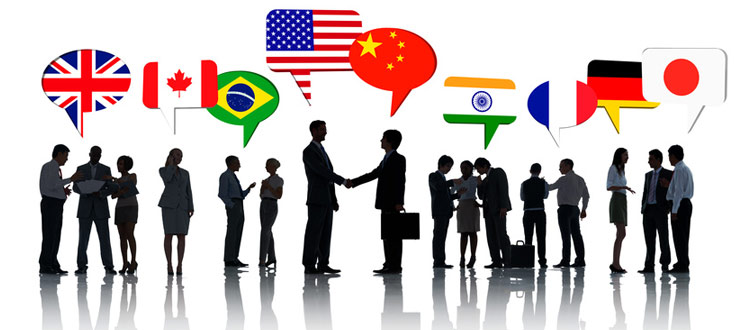
A JAD session - short for Joint Application Development session -  is a structured meeting that brings together business users, developers, and analysts to collaboratively define system requirements or design solutions. It’s particularly useful during the early stages of a software project.

JAD was a response to slow and error-prone traditional methods of gathering system requirements going way back to the 1970s, a methodology developed at IBM by Chuck Morris and Tony Crawford.

SSADM - Structured Systems Analysis and Design Method - dates back to the early 1980s. It was developed under contract to the UK government’s Central Computer and Telecommunications Agency (CCTA) as a standardised method for analysing and designing information systems.

By the mid 1990s, SSADM was on the way out due to the rise of RAD (Rapid Application Development), Agile, and object-oriented methods.

Object-Oriented Methods (OOM) are a way of designing and building software systems based on the concept of “objects”. These are self-contained units that combine data and behaviour, an approach mirrors the way we understand real-world entities like a car, a user, or a booking.. each has its own characteristics and actions.

An object has

- Attributes (data/state) — e.g., a User has a name, email, password.

- Methods (behaviour) — e.g., a User can log in, edit a profile, make a booking.

- Objects belong to classes, which are like blueprints for creating multiple similar objects. User gives hosts and guests.


🔍 What Happens in a JAD Session?

  • Facilitated workshop, often lasting several hours to a few days
  • Focused on rapid consensus-building
  • Participants work through use cases, data flows, interfaces, or UI mockups
  • Typically led by a facilitator, with a scribe, users, and technical experts
Business users who know the domain
Analysts who map the requirements
Developers who understand system capabilities

🧩 Typical Roles in a JAD Session

Role Responsibility
Facilitator Guides the discussion, ensures all voices are heard
Scribe Takes detailed notes, records decisions and diagrams
Business Users Share domain knowledge, describe real-world processes
Developers Ask clarifying questions, assess technical feasibility
Analysts Translate discussion into models, user stories, or specs

✅ Advantages

  • Cuts down on back-and-forth emails
  • Produces a shared understanding of goals
  • Captures accurate, detailed requirements
  • Increases buy-in from all stakeholders

📌 Use Case for Rentals

If rhe team were all co-located or online for a few hours, it would be possible to run a JAD session to:

  • Finalise feature priorities for the MVP
  • Walk through the booking flow from a user's perspective
  • Agree on UI elements based on tester feedback
  • Tackle tricky areas like deposit handling or ICal sync

Here's a JAD session agenda or template for the team.


📌 JAD session agenda

- 🎯 Purpose: Finalise MVP features, align design + functionality Participants: • 

Facilitator: Project lead analyst • Developers: [Insert Names] • Testers / Users: [Insert Names]

Session Agenda:

1. Welcome + Goals Overview (10 min)

2. Review of Core User Flows (20 min)

3. Feature Prioritisation Discussion (20 min)

4. UI/UX Walkthrough with Feedback (20 min)

5. Issue Resolution and Open Questions (15 min)

6. Wrap-up + Action Plan (5 min)

[End]

Friday, 25 July 2025

KENNETH CLARK CIVILISATION

25 July 2025

The Louvre Abu Dhabi - a cathedral of human expression

From Cathedrals to Water Cannons: What Our Art Says About Us

1. REWINDING TO CIVILISATION'S GLORY

Let’s fast backward to the 1960s. Kenneth Clark - gentle, eloquent, with a cork-tipped cigarette in hand, clambering over rocks on an Ionian beach in clothes fit for the City of London - reminded a postwar Britain of its cultural inheritance. His television series Civilisation ( a thirteen episode series recorded in 1969, watch episode one here) began with the bold idea that art tells the truest story of who we are.

Clark quotes John Ruskin, who said that among words, deeds, and art, it is art that stands as the most reliable testament to a nation’s character. Not the art of elites or museum showpieces, but the art that emerges from the connected soul of a people, our feelings and preoccupations.


2. WHAT DOES OUR ART SAY TODAY?

So what would Ruskin see if he walked through today’s culture? Not soaring cathedrals or visions of the divine, rhat's for sure.

Instead, we get:

  • Banksy’s Dismaland – Mickey Mouse cries and Cinderella lies dead in a crashed carriage... he's mostly about the mockery of consumer dreams
  • BLM street murals – bold and defiant, transient (where are rhey today?) protest, etched onto the streets
  • Internet memes – Wojak "Everything is fine", the NPC Non-Playable Character (NPCs are background characters in video games you can't control. They follow scripts, show no free will, and repeat pre-written dialogue). All rhat post-ironic nihilistic disillusionment stuff ... You either believe the propaganda or you mock it so much that you end up half-believing it, because there's nothing else to believe in, no more heroes, no more values.
  • A 15-metre mural of Greta Thunberg – submerged in climate anxiety, up to her neck in rising water

You wouldn't call this uplifting, it's about struggle and despair in the midst of abundance, the artist talking for the protesters as much as the NPCs.


3. FROM GLORY TO GRIEF

What once inspired our greatest works was the glory of God. What inspires today's artists seems to be struggle, cynicism, despair....is rhat how you - looking out at the world today - feel? Well this is your art.

In Clark’s world, beauty was in sacred proportions.

  • The chateaux of the Loire Valley
  • The grace of Chartres, Notre-Dame, or Florence’s Duomo
  • A civilisation, a people, striving toward something higher, celebrating the glory of God.

Today? You don't see much of that today. Instead, we have global expanses of glass and concrete. We no longer celebrate our civilisation with art. We criticise it, and often with the ugliest works we can dream up.

Still, there is a modern day Louvre, but it's not in Europe, it's in the middle east. The Louvre Abu Dhabi seeks "to modernise while honouring heritage". In other words, build on the past, rather than destroy ourselves.


4. THE NEW SYMBOL OF THE WEST

And if there’s one object that captures what we are today, it’s not the cross, not a dome, it’s the water cannon. Wheeled out to meet protest, unrest, the rage of a discontented citizenry, it's all about containment - kettling, containment and state control.

🤣🤣🤣


5. POSTSCRIPT

What Clark began with Bach and Michelangelo, we’ve answered with graffiti and memes. But Ruskin wasn’t wrong. Our art still tells the truth. It tells us the West is in crisis. It tells us that in a way we’ve lost the script... will we find a new story worth carving in stone? Or will our civilisation fade from memory?

‘My name is Ozymandias, king of kings:

Look on my Works, ye Mighty, and despair!’

Nothing beside remains. Round the decay

Of that colossal Wreck, boundless and bare

The lone and level sands stretch far away.”


Wednesday, 23 July 2025

TRUMP AT THE END OF EMPIRE CAFE

24 July 2025

TRUMP AT THE LAST CAFÉ BEFORE THE END OF EMPIRE

Policy contradiction, chaos, and the strange logic of leadership at the end of empire café.

1. A Loose Cannon with a Steady Aim

Trump is a loose cannon… anything is possible”, writes a reader. It’s a phrase tossed around by both supporters and critics of Trump, and there’s something paradoxically fitting in it. When he came to power, he did so with three grand, populist ambitions:

- To rebalance the economy - trade, fiscal, and monetary

- To shut the border and end uncontrolled immigration

- To stop America’s endless wars abroad

This sounds like a blueprint for restoring a strong and independent republic. But when you begin to break these aims into actionable objectives, the contradictions start piling up.

2. Contradictions at the Heart of Empire

Take the trade imbalance. If you want to bring manufacturing home and reduce interest payments, currently 20% of US government expenditure, you need to make exports cheaper and lower rhe Fed rate... which means lowering the dollar. But that undermines the dollar’s status as the world’s reserve currency and how do you attract the capital needed to fund the deficits without offering high yields?

Or immigration. Shutting the border sounds like a clean solution... until harvest season. Then the cries go up from farmers, builders, and meat-packing plants and employers of casual workers, desperate for the cheap labour that fuels the economy Trump vowed to revive.

Or stop using military muscle to resolve foreign policy conflicts. How could America withdraw from the world and at the same time remain world hegemon, and keep the military-industrial-congressional complex going?

These internal contradictions - breaking out foreign and domestic policy goals into spews of contradictory objectives - are never resolved, they can't be, they are simply masked, not by policy but by performance. 

The real idea is to spend as long as possible in the last cafe before the end of empire.

3. The Perfect Liar for the Age of Collapse

Trump’s greatest political skill may be his total indifference to consistency. Facts, figures, coherent positions, matter less to him than the mood of the moment and the needs of his publics. He may seem to be flip-flopping and continuously changing his mind, but reality means he will say what he needs to say to whoever is in front of him, regardless of long term goals, regardless of the truth. And that’s exactly why he can survive the contradictions of this age of end-of-empire.

While powerful interest groups - AIPAC, the military-industrial-complex, Wall Street whose taxes incidentally fund the government at least in part, the agricultural lobby, the fossil fuel billionaires, the tech firms - all pull in opposing directions, Trump rests on his MAGA base end keeps the interest groups at bay with a barrage of contradictory poses and stories. His genius isn’t in strategic clarity. It’s in ambiguity and showmanship... in promising everyone what they want... and then changing the story by lunchtime.

In this sense, he is the ideal manager of late imperial decline. At the Empire Café, with the walls cracking and the staff revolting, he’s the maître d’hôte who smiles, lies, distracts, entertains, horrifies... and survives.

4. Anyone Would Lie in That Job

Let’s not pretend this is unique to Trump. Any President - be it Kamala Harris or Michelle Obama - would face the same contradictions. They too would lie, flip-flop, and pacify different constituencies with carefully tailored half-truths. The problem isn’t Trump. The problem is the stage on which he performs: a collapsing empire with no possible coherent plan for what comes next.

I’m reminded of a moment from the history of 1960s Britain. Harold Wilson, speaking in the port city of Rochester, was bragging about his defence plans. “And why do I emphasise the importance of the Royal Navy?”, he asked his audience. Someone in the crowd shouted back: “Because you’re in Rochester!”

Wilson was an early Trump in a way:  knowing that political truth is local, emotional, and, above all, disposable.... leave your critics behind you in the dust of your lies.

5. Final Thought

So yes, Trump is a liar. But perhaps, in this age of imperial chaos, only a liar can hold the centre together. Not because the lies fix anything, they can'r, other than get you power. But because they delay the collapse by a few more seasons.

Is that admirable? Or is it terrifying? Only history can decide....

"Trump at the Empire Café"
 The last cafe before the end of the empire.

[End]

Tuesday, 22 July 2025

WHAT TO DO WITH THE GRANGEMOUTH TERMINAL SCOTLAND

22 July 2025

Grangemouth’s closure is not the simple tale of a dying industry, but a more complex strategic retreat forced by economic inevitability. 

Originally a BP asset, the refinery passed through Innovene to INEOS in 2005, and since 2011 has operated as a 50/50 joint venture with PetroChina under the name Petroineos. Despite media and union claims of chronic losses, financial records show the refinery was profitable in most years, generating £80 million in 2022 alone. A major loss reported in 2020 was largely a one-off accounting impairment, not a collapse in operating performance. The company claims to be losing £385k a month.The shutdown of crude processing in April 2025, despite recent profitability, suggests the decision might have been driven by long-term strategic factors, not only short-term insolvency.

This move marks a wider move across Europe, away from domestic refining towards fuel import & distribute hubs, as part of dealing with longtime over-capacity in the refining industry and “green” restructuring. 

Around £50 million was allocated to convert Grangemouth into an import-and-distribution terminal, aligning with INEOS and government decarbonisation agendas. The result: roughly 400 direct jobs lost, alongside local economic fallout through the extended supply chain. Yet companies like Scottish Power are already stepping in to rehire displaced engineers into renewables. This is a market failure, followed by a deliberate transformation of national energy infrastructure... though it is presented to the public in the language of crisis. 

Grangemouth must be reappraised in the light of market over capacity and technology advance. Its model must be updated to fit.green "pivot" and consequent regulatory path chosen by political and corporate elites.

☆☆☆

Detail on Grangemouth

The as-is:

*Ownership*

 50/50 joint venture (INEOS & PetroChina), not wholly INEOS-owned, half Chinese

*Profitability*

 Profitable outside a 2020 anomaly, but claims of monthly losses of £385k is why CEO Ratcliffe pulled the plug finally

*Strategic Shift*

 Transitioned to an import terminal, same in Europe due to global overcapacity in refining and newer, low cost plants in asia and elsewhere. This over capacity dates back many years, but now as a result of the green pivot it is only getting worse. Why did Ratcliffe even buy Grangenouth? It's only because it was his part of this niche industry.

*Economic Impact*

 Hundreds of jobs at risk, but there are still two local green investment possibilities that could offset some job losses.

*Conclusion*

 Ratcliffe couldn't sell it and the government doesn't want to or can't invest enough (£225m on a 50-50 basis). This tells us that this piece of industrial infrastructure is past it's expiry date and needs to be updated or removed. What's happened is that Ratcliffe tried to repurpose it, but reality is the global economy and technology have moved on and left it standing still.

*What to do*

 There could be a strategic push here for low cost, competitive refining advantage, that would give Scotland some control over, it's energy supply instead of being victim. Two the global market. 

 But it's also true that there's not much you can do about job losses, these are inevitable, other than retrain the workforce into new technology roles... And that's the job of government.

*Options*

Option 1: Green Energy Hub & Fuel Import Terminal 

Transforming Grangemouth into a low-carbon hub under Project Willow is a long-term investment (£3.8 billion over ten years to £13 billion in a full rollout...roday's estimates only) . 

The plan relies on private capital, alongside a £200 million UK and £25 million Scottish government commitment, to deliver nine green projects (recycling, biomethane, sustainable aviation fuel, hydrogen, e‑ammonia) via synergies with the Acorn CCS scheme. Plastic recycling alone may cost about £600 million and employ ~250 people, while larger facilities like SAF -

 (Sustainable Aviation Fuel), a low-carbon alternative to traditional jet fuel, made from biomass, waste oils, or synthetic feedstocks. It can reduce lifecycle emissions by up to 80%, and is a key plank in UK and EU net-zero aviation strategy -

or hydrogen plants. Rhese could require up to £800 million each ro set up. Supporters project 800–1,750 jobs by 2040, but success hinges on favourable regulations and sustained investment 

Option 2: Restart Refinery via Hydrocracker Revival 

Reactivating Grangemouth’s hydrocracker and processing North Sea crude offers a quicker, lower-cost route focused on preserving core infrastructure. MPs and unions estimate a £60–80 million investment to restart the hydrocracker. Additional upgrades such as connecting to the Forties pipeline and adapting for North Sea streams like Rosebank, would require further uncosted, unspecified, engineering expenditures. This strategy could potentially triple profitability, maintain existing jobs, and support a transition in the interests of the community, as part of the site's future biofuel roll-out. However, it doesn’t address long-term decarbonisation, and would require parallel green investment.

Summary:

Option 1 demands £3.8–13 billion in green investment (public + private), targeting a transformational renewable hub with long-term job growth.

Option 2 needs a £60–80 million injection to preserve refining capability, buy time, and sustain local employment while transitioning more gradually.


Final Conclusions

As a piece of industrial infrastructure, Grangemouth is well out of date. It has been overtaken by newer plants, by over-capacity in the industry, buy a switch to renewables, by more modern clean technologies. On economic grounds, it should be updated requiring considerable investment or the entire area repurposed - perhaps as an aeronautical construction site, servicing the burgeoning aeronautical engineering talent in Edinburgh.

Inevitably, in any industrial transformation, the workforce will be reduced and the government needs to step in with retraining programs.

From a strategic point of view, the objective must be for Scotland to retain independence and control in its energy supply. But equally, creative plans are needed for new strategically important industries in Scotland, things can be made, and this site could be the basis for that renewal - MSGA. Take Strata as an example.


Sunday, 20 July 2025

THE UK GOVERNMENT'S SUPER INJUNCTION

21 July 2025

What's this fuss about a super injunction? And the 30,000 who are being integrated into the UK?


- Unprecedented secrecy: first known instance of a government using one a super injunxtion (silly name)

- Democratic failure: we were all denied oversight for nearly two years

- Risk - reward miscalculation: judge told rhe MoD risks were overestimated, yet the gag remained in place

- Public trust eroded: how many more cockups are being covered up; why did a labour Prime Minister cover up for the Tories, like for the elite?

Well maybe it was a cock-up, but Ida thought that these are exactly the kind of people that the UK wants - educated and loyal and young - what a scoop!

There we go - what might have been a positive thing and in accord with a moral duty, has instead turned into a political scandal over secrecy and accountability.

Who gives a damn - they were only loyal afghanis.

As u wld say, "what a mess". As Mearsheimer says, " they've got the meidas touch in reverse"... everything they touch turns to s**t.

Saturday, 19 July 2025

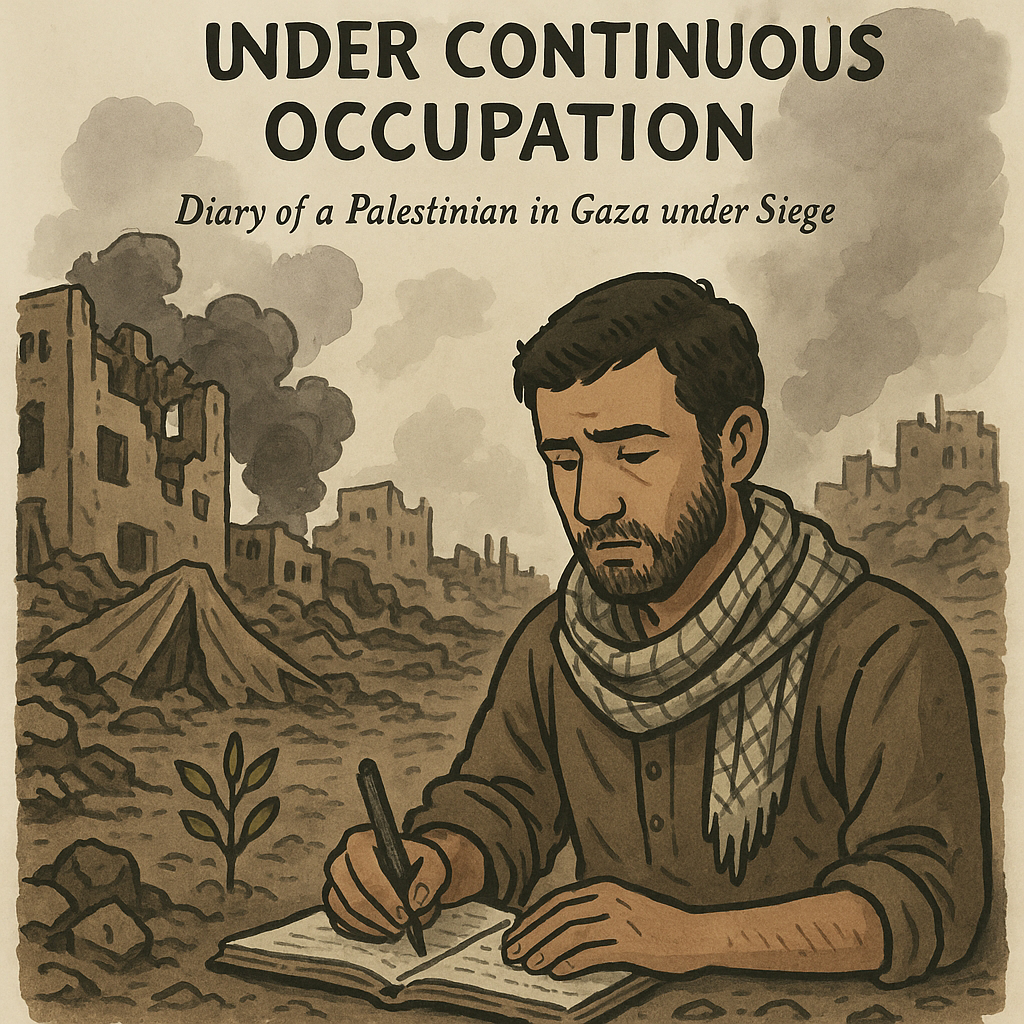
DIARY OF A PALESTINIAN IN GAZA UNDER SIEGE

19 July 2025

LIVING UNDER CONTINUOUS OCCUPATION
Diary of a Palestinian in Gaza under Siege


1. “Waking in Ruins”

I wake up under broken concrete. The ceiling trembles with each distant strike. We used to live in homes, now we live in craters, tents, or what used to be schools. There is no morning routine, only the next decision: Where do we hide today?

They tell us to evacuate, but there is nowhere safe to go. We are caged inside Gaza, a 40-km strip surrounded by concrete walls, drones, and watchtowers.


2. “This Is Not a War Zone. This Is a Prison”

Gaza is blockaded by land, air, and sea. We cannot leave. We cannot fish. We cannot import medicine, building materials, or fuel freely. Even drinking water is rationed. Electricity comes for 1–2 hours a day, if we’re lucky. The UN calls this the world’s largest open-air prison. We just call it home.


3. “Why We Are Russian-Speaking in the East”

Just as Ukraine has its Russian-speaking east - rooted in the legacy of Catherine the Great - Palestine has its demographic fault lines. Gaza, dense and coastal, was filled with refugees from cities like Jaffa, Haifa, and Ashkelon in 1948. My grandmother was born in Jaffa. She fled on foot during the Nakba, barefoot and bleeding.

That was her story. Now it's mine... again.


4. “The Bombs Do Not Ask for IDs”

We hear leaflets dropped from planes, robotic voices over loudspeakers: Evacuate the building in five minutes. And then... silence. Sometimes the bomb comes anyway. Sometimes it comes while you are packing.

Hospitals have been struck, the Indonesian hospital. Ambulances destroyed. UN shelters hit. Cemeteries bombed. Over 100,000 civilians dead, probably nearer half a million. More than 30,000 children. We keep digging with our bare hands. The smell of death is everywhere.


5. “Even Language Is Resistance”

They want us to forget, forget our villages, our identity, our songs. They call us “human shields” or “terrorists” for simply being here. But we still speak Arabic. We still say our village names. We write poetry. We bury the dead by name, not number, when we can. We remember in our prayers.

Our bookshelves are now rubble, but we still recite Mahmoud Darwish by heart.


6. “What It Means to Stay”

I could try to flee. Some tunnels remain. Some bribes still work. But I stay. Why? Because this is Palestine. If we all leave, they will say: They are gone. It is ours now.

So we stay. Not because we love war. But because we love this soil too much to let it be stolen again.


7. Final Reflection: We Still Exist

To be Palestinian in Gaza today is to exist between grief and resistance. Our lives are disposable to the world’s powers. But our memory is not. Our children draw keys on the walls as symbols of the homes we lost in 1948. We teach them that even under siege, dignity survives.

We whisper to them each night: You are not victims. You are descendants of return.


DIARY OF A RUSSIAN-SPEAKING UKRAINIAN

LIVING BETWEEN WORLDS
Diary of a Russian-Speaking Ukrainian in Wartime

1. "I Am Home, But Not Welcome"

I was born in Kharkiv. My parents spoke Russian, as did their parents before them. It was never a statement, just a language, our language. But today, even my words are suspect. When I speak Russian in the market, the stares are sharp. I’ve stopped answering my phone in public.

They say I'm "not Ukrainian enough." Yet I pay taxes, shelter neighbours, mourn the dead, and dream of peace. What more do they want?

2. "This Land Was Always Layered"

One-third of this country speaks Russian. That’s not because we invaded, it’s because of history. Eastern Ukraine - what Catherine the Great called Novorossiya - was settled, built, and cultivated by Russians and Russified Slavs under the Tsars.

The west - which is Lviv, Ivano-Frankivsk - was once part of the Polish-Lithuanian Commonwealth and later Austria-Hungary. They look to Rome, to Vienna. The centre - Kyiv, Dnipro - is a mix, always balancing.

We are not one nation in the romantic sense. We are a layered civilisation. Yet today's government demands we be one language, one history, one faith.

3. "The Law Has a Sharp Edge"

I used to teach literature... in Russian. Now, by law, I must switch to Ukrainian. I don’t mind the language itself. What I mind is the erasure.

Russian books are being removed from libraries. Plays cancelled. Street names changed overnight. They say it's "decolonisation". I say it's a war on memory.

My daughter’s school no longer offers Russian as a subject. She speaks it at home, but she’s learning to be ashamed of it.

4. "Everyone Is Afraid of Being Labelled"

If I criticise Zelensky’s war policies, they say I support Russia. If I speak Russian, I’m called a "Muscovite." I oppose the invasion, but I also oppose the burning of everything Russian in this land.

There is no room for nuance. It’s either Bandera or Putin. I choose neither.

5. "Meaning in the Ashes"

I still read Pushkin. I still cook from my grandmother’s Tatar recipe book. I still light candles in a Russian Orthodox church, though it may soon be banned. These are not betrayals. These are my inheritance.

I am a Ukrainian citizen. I love this land. But I cannot amputate my past to prove it, it is part of who I am.

So I live quietly. I teach my daughter both languages. I speak Ukrainian in public, Russian at home. I tell her: you are both, and you are not wrong.

6. Final Reflection

Living in Ukraine as a Russian-speaker today is not war, rather, it is exile without actually leaving. You are present but you are mistrusted. You are asked to forget, to self-edit, to shrink.

But we do not shrink. We remember. And memory, in this strange civil war of identities, is resistance enough.

1. Introduction: Ukrainian Citizen, Russian Heritage

To live in Ukraine as a Russian-speaking citizen under Zelensky’s government is to face a deep identity crisis. You are part of the nation—but your language, culture, and even your lineage are treated with suspicion, regulated, or actively suppressed.

This is not a post about war crimes or frontline politics—it’s about daily life, personal meaning, and navigating a society where your voice is tacitly...or openly... marginalised.

2. Legal Framework: Language and Identity

Ukraine’s 2019 language law made Ukrainian the required language for government, media, education, public services and even signage .

Print media must have a Ukrainian equivalent, and half of newsstands must stock Ukrainian-print items .

Russian-language education at all levels is heavily restricted; only EU languages were allowed apart from Ukrainian .


These laws aim to consolidate national cohesion, but critics see them as discriminatory—especially toward Russian-speakers (who are around a third of the population) .

3. Daily Life Impact: Alienation or Resistance

Bureaucracy and public services: You must use Ukrainian to fill forms, interact with civil servants, or access healthcare—languages you may not be fluent in.

Education: If you have children, their schooling is in Ukrainian. Studying in Russian is almost impossible now.

Culture & community: In Kyiv and other cities, public events in Russian are rare. Russian books, plays, and music face bans .

Social stigma: Speaking Russian in public spaces may draw sideways glances, suspicion, or even hostility, especially amid wartime tension.

4. Emotional Landscape: From Pride to Exclusion

You may oscillate between:

- Pride in Ukraine’s struggle for sovereignty.

- Anger or sorrow at losing your mother tongue’s public presence.

- Fear of being labelled "pro-Russian" or “Nazi sympathiser”, no matter your actual views.

- Isolation: You look for meaning in family, faith, or art rather than national identity.

5. Attitude: Paths for Identity Navigation

A. Quiet Resilience

You live “in two tongues”: speak Russian at home, Ukrainian in public.

You preserve your culture privately such as music, literature, traditions.

You avoid politics, focusing on daily life.


B. Cultural Resistance

You support or volunteer in communities keeping Russian heritage alive.

You push for local bilingual schooling or media.

You seek alliances with other minority-language groups.


C. Emigration or Withdrawal

You leave Ukraine for Russia, Europe, or elsewhere to freely speak your language.

Or, you mentally detach... stay physically, but emotionally retreat.

6. Glossary

Derussification: Removing Russian influence—language, monuments, place names—across Ukraine .

Marginalisation: Being pushed to the fringes—socially, culturally, legally—because of language or heritage.

Quiet resistance: Small acts of preserving identity under pressure.

7. Final Reflection: Living Between Worlds

As a Russian-speaking Ukrainian, your existence itself is political. You carry multiple loyalties. Every word you speak is a statement. In wartime Ukraine, your identity is not just personal; it is scrutinised. Yet your life continues—not out of ideological purity, but because you seek meaning amid exclusion: in home, language, art, and hope that identity can coexist with sovereignty.


BEING ISRAELI BUT NON ZIONIST

19 July 2025

1. Introduction: Being Israeli but Non-Zionist

To be Israeli but non-Zionist today is to live in profound contradiction. You belong to a society founded on an ideology you reject - yet you're still a citizen, participant, and witness to its actions. Your passport, language, and daily life are Israeli. But your moral compass, historical understanding, and political ideals may be radically out of sync with your surroundings.

It’s not just an intellectual tension - it’s an existential one.

2. Core Dilemma: Home vs Ideology

A non-Zionist Israeli may feel:

Alienation: from the national narrative, which frames the state as the natural and just return of the Jewish people.

Guilt or complicity: for living on land acquired through displacement and maintained by military domination.

Exclusion: from mainstream discourse, which assumes Zionism as a baseline for loyalty and belonging.

And yet:

This is your home, you may have been born there, raised your children there, speak Hebrew, love the land.

You may be against Zionism, but also afraid of what would come if the system collapsed chaotically.

3. Your Possible Attitudes and Strategies

A. Ethical Dissent Within

You choose to stay and speak out.

You align with human rights groups (e.g. B'Tselem, Breaking the Silence).

You may view Israel as a state in need of radical transformation - not destruction, but de-Zionisation (i.e. from ethnocracy to full democracy).

You support equal rights, truth-telling about 1948, and a shared future with Palestinians.


B. Cultural Israeli, Political Stateless

You disconnect from nationalism entirely.

You live privately, culturally Jewish or secular, with little public engagement.

You might feel like a resident rather than a citizen—physically present, spiritually in exile.


C. Emigration (Yerida)

You leave. You cannot reconcile your values with life under a Zionist regime.

You may become part of the Jewish diaspora again, but as a critic of Israeli policy.

But leaving doesn’t guarantee peace—it may provoke accusation of betrayal and permanent inner exile.

4. Historical Role Models or Examples

Yeshayahu Leibowitz – Orthodox Jew, Israeli citizen, fiercely anti-Zionist. Called the IDF in the Occupied Territories "Judeo-Nazi."

Ilan Pappé – Jewish Israeli historian in exile, accused Zionism of ethnic cleansing.

Miko Peled – Son of an IDF general, now advocates for a one-state solution with full equality.

Uri Avnery – Longtime peace activist, believed Israel must reconcile with Palestinian rights or self-destruct.

5. Day-to-Day Reality

As a non-Zionist Israeli, you might:

Face social ostracism - Zionism is not just a policy, it's the state religion.

Be accused of being self-hating or worse, “anti-Semitic.”

Live in a state of cognitive dissonance: shopping in Israeli stores, served by Palestinian labour, protected by soldiers you don’t support.

Be caught between complicity and impotence.

6. Glossary

Zionism: Political ideology advocating for a Jewish nation-state in Palestine.

De-Zionisation: A radical idea proposing the transformation of Israel into a neutral, democratic state without ethnic preference.

Yerida: Emigration from Israel—often viewed negatively within Zionist discourse.

Ethnocracy: A regime where one ethnic group dominates the state structurally.

7. Final Reflection

You would likely live with the painful awareness that you are part of a state built on dispossession—but not because you chose it. You might see your role as bearing witness, telling the truth, and refusing to normalise the occupation. Whether you stay or go, your dissent becomes your identity.

LIFE UNDER NEOCON RULE IN THE WEST

19 July 2025

Living Under Neocon Rule in the West

1. Introduction: Life Under Neocon Rule in the West

To live in a Western country today while rejecting Neoconism - the ideological engine behind endless war, imperial arrogance, and elite impunity - is to face a profound existential contradiction. You are a citizen of a system whose external policies you find abhorrent and whose internal decline you witness daily. Like the non-Zionist Israeli, you ask: How can I live truthfully under an empire I did not build, do not consent to, and cannot control?

2. What Is Neoconism?

Neoconservatism (or Neoconism) is not a religion, but it functions like one: a belief system with sacred myths, high priests, and sanctioned rituals of violence.

Key doctrines:
• Permanent military superiority
• The right to intervene anywhere, anytime
• Export of liberal democracy via war and regime change
• Disdain for international law unless it serves US interests
• Moral exceptionalism ('We are the good guys')

3. What You Might Feel: Internal Exile in the West

As a citizen who sees through this apparatus, you may feel:
• Disgust at the hypocrisy: preaching human rights while bombing hospitals.
• Despair at the media: recycling war propaganda with zero memory or shame.
• Impotence politically: real debate excluded, elections offer no alternative.
• Social isolation: your views marginalised, mislabelled as “conspiratorial” or “pro-Russian/Chinese/Iranian.”
• Moral exhaustion: watching Gaza, Ukraine, and Syria burn with your taxes.

4. Ways You Might Respond

A. Ethical Witness
• You remain within society but refuse its myths.
• You write, educate, share, resist soft lies.
• You support independent media, whistleblowers, anti-war veterans.
• You preserve your moral clarity, even in isolation,
 You demonstrate, object, parade in the streets
 "We are eirher sovereign and free, or we do not exist."

B. Parallel Citizenship
• You invest in local, cultural, familial meaning.
• You reduce dependence on official structures (off-grid living, homeschooling, local food).
• You treat your state like a foreign occupier: obey the law, but give no loyalty.

C. Strategic Withdrawal or Emigration
• You move abroad, seeking refuge in politically neutral or spiritually saner societies.
• You become part of an inner diaspora: expatriate in soul, even if not in body.
• But you may find disillusionment follows yo, because the empire is everywhere.

D. Internal Resistance
• You join anti-imperialist, anti-globalist political movements (some on left, some on right).
• You risk being surveilled, smeared, deplatformed - but retain your dignity.
• You work to rebuild sovereignty from below: town halls, independent schools, local economies.

5. Historical Analogues

• Dissidents in the Soviet Union during the Brezhnev era - “we pretend to work, they pretend to pay us.”
• Non-Communist intellectuals in Tito’s Yugoslavia — apathetic, alienated, yet clinging to language, family, and books.
• Artists and thinkers under Fascism - choosing silence, exile, or coded resistance.

6. Glossary

• Neoconism: Ideology advocating for unipolar dominance through military and cultural control.
• Internal exile: The state of living within a country but mentally and morally estranged from its regime.
• Empire of lies: A regime that projects morality abroad but crushes it at home.
• Multipolarity: The idea of a world with several sovereign power centres - not one global hegemon.

7. Final Reflection: Dignity in the Ruins

If you are a Western citizen opposed to Neoconism, your position is not hopeless, but it is exilic. You must build truth, beauty, and meaning amid the wreckage. You are not alone, even if the system makes you feel so. The world is changing - and in that turbulence, there is space for resistance, renewal, and quiet rebellion.

Friday, 18 July 2025

RENTALS MVP DATABASE SCHEMA

18 July 2025

1. Objective

To design a relational database back-end for a small short-term rentals business, using an Agile development approach.

The goal is a solid database schema that supports bookings, calendars, payments, reviews, messaging, etc., for a website-based Property Management System (PMS).

2. Step-by-Step Methodology (Agile-aligned)

2.1. Define MVP Scope and Roles (Agile: Product Backlog)

Identify the core features the database must support:

Properties

Availability & Bookings

Hosts and Guests

Messaging

Payments

Define user types:

Host (owner or manager)

Guest (renter)

Admin (yourself or future superuser)

Create high-level User Stories:

“As a guest, I want to book a property, so that I can stay during my trip.”

“As a host, I want to manage my property calendar, so that I avoid double bookings.”

2.2. Identify Entities and Relationships (Agile: Sprint 0 – Architecture planning)

Create an Entity List based on user stories. Typical entities:

Users (hosts, guests, admins)

Properties

Amenities

Bookings

Calendar

Payments

Reviews

Messages / Enquiries

Draw relationships:

One host → many properties

One guest → many bookings

One booking → one property

Many-to-many: property ↔ amenities

2.3. Define Primary Keys and Foreign Keys (Database Normalisation)

Every entity gets a primary key (PK)

Use foreign keys (FK) to establish links

E.g., property_id in bookings table

Use surrogate keys (like UUID or auto-increment ID)

Avoid data duplication: follow 3rd Normal Form (3NF) unless performance says otherwise

2.4. Build the Logical Data Model (Agile: Deliverable of First Sprint)

Create a visual ERD (Entity Relationship Diagram)

Use standard notation (Crow’s foot or SSADM box-style)

Colour code:

Green = Master Data (users, properties, amenities)

Blue = Transactional Data (bookings, payments)

Purple = Others (messages, reviews)

2.5. Validate with User Stories (Agile: Sprint Review & Feedback)

Review each user story:

“Can this data model support the scenario?”

E.g., “Does the booking table include guest ID, property ID, dates, and status?”

Adjust schema if necessary

2.6. Prepare for Sprint-Based Dev Build (Agile: Incremental Development)

Export schema for developers (SQL or DBML)

Link database to front-end via REST or GraphQL API

Use iterative Agile sprints to:

Add features (e.g., cancellation handling, discounts)

Refine performance

Handle edge cases (e.g., double bookings, partial refunds)

2.7. Test, Iterate, Deploy (Agile: Sprint Cycles)

Unit test DB schema (e.g., FK constraints, NOT NULL, ENUM values)

Mock data to simulate real-world use

Start with local DB (SQLite or Postgres)

Migrate to cloud-based DBMS (AWS RDS, Firebase, Supabase)

3. Final Thoughts

This method blends Agile’s iterative design with relational database rigour. The key is modularity: build minimum core features first, then expand in layers. Each sprint delivers something usable and testable — just as Agile intends.


Rentals MVP Database Schema

Master entities (green): hold reference data 
- users, hosts, guests, properties, amenities

Transaction entities (blue): record activity or events 
- bookings, payments, calendar, reviews

Junction Tables (purple): resolve many-to-many relationships or track system-level changes 
property_amenities, booking_events

Log or Event Entities: capture state/history 
- booking_events records the lifecycle of a booking (confirmed, paid, cancelled etc.)
Cross between audit logs and system workflows. Not true “transactions”, but they are time-sensitive and often append-only


Glossary

MVP – Minimum Viable Product, the smallest functional version of our system
User Story – short statement describing what a user wants to do and why
3NF – Third Normal Form, a method of designing databases to reduce redundancy
ERD – Entity Relationship Diagram, visual map of database tables and relationships
Sprint – a short development cycle (typically 1–2 weeks) in Agile methodology


A HISTORY OF THE AGILE METHODOLOGY

18 July 2025


1. Overview

The Agile methodology is a set of principles for software development that prioritise flexibility, customer collaboration, and quick delivery over rigid planning and documentation.

2. Origins of Agile

Before Agile, software was typically developed using the Waterfall model – a linear, sequential process.

Problems arose: requirements changed mid-project, documentation-heavy processes slowed delivery, and customers often got what they asked for but not what they needed.

3. Precursors to Agile
Several lightweight, iterative methods emerged to address Waterfall's weaknesses:

Rapid Application Development (RAD)

Scrum (developed in the 1990s)

Extreme Programming (XP)

Feature-Driven Development (FDD)
These shared similar values: shorter cycles, user involvement, and adaptability.

4. The Agile Manifesto (2001)

Seventeen software developers met in Utah and created the Agile Manifesto, which formalised Agile principles.

It valued:

Individuals and interactions over processes and tools

Working software over comprehensive documentation

Customer collaboration over contract negotiation

Responding to change over following a fixed plan

5. Post-Manifesto Evolution

Agile grew into various frameworks like Scrum, Kanban, Lean, and SAFe.

Widely adopted across industries, not just in software.

6. Conclusion
Agile emerged as a reaction to rigid methodologies. Its success lies in delivering usable software faster while adapting to change and maintaining close collaboration with users.

Glossary
Waterfall Model – a step-by-step, linear approach to software development.
Iterative – a cyclical process where feedback and adjustments happen continuously.
Agile Manifesto – a declaration of the core values and principles guiding Agile.
Scrum/XP/FDD – specific Agile frameworks or methodologies.

Source:

[End]