6 July 2025
Yesterday, we looked at
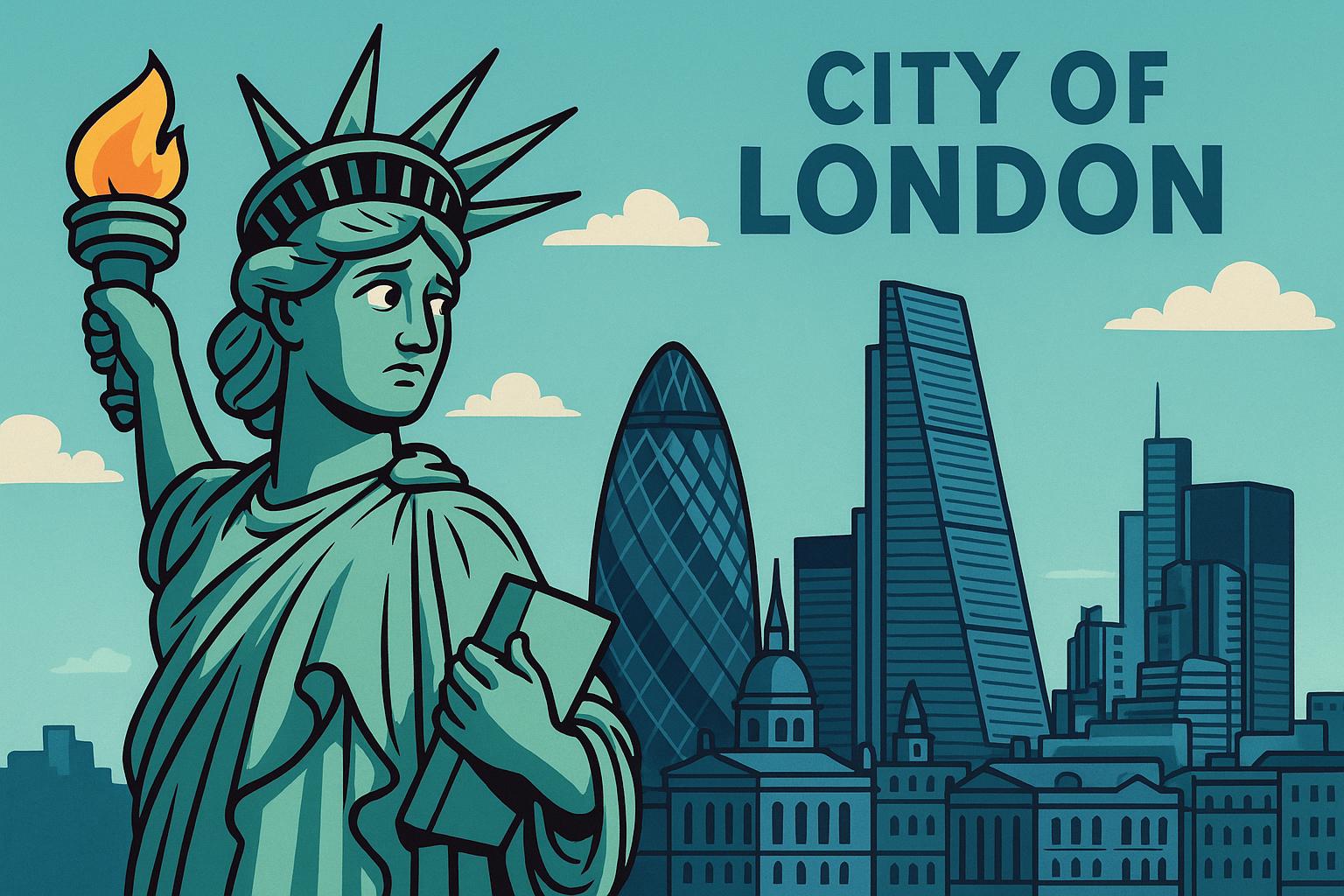
Britain's influence over Washington. In this post, we shall consider the view that “all that’s left of the British Empire is the City of London”, and that financial power, not military empire, remains Britain’s legacy and its tool of influence.
1. The City of London: What Is It?
The City of London (not to be confused with Greater London) is a tiny, ancient jurisdiction - a square mile - with its own Lord Mayor, its own police force, and a certain legal status. In practical / financial matters, it is one of the three global nodes of finance alongside Wall Street and Hong Kong / Shanghai.
The British Empire once ruled over a quarter of the world's land and people, with its authority backed by naval power, colonial governors, and direct political control. Today, the Union Jack no longer flies over distant dominions, but the empire has not vanished, it has evolved from military rule to financial rule. A rule centred in the City of London and its offshore networks, where influence flows quietly through law, money, and global finance.
So the British Empire has faded in a military, overt power and control sense, but the City remains an empire of financing capital: a global command centre for currency trading, offshore finance, investment banking, and legal arbitration.
2. What Are Its Powers?
Here are the core instruments of financial power based in or routed through the City:
2.1 Foreign Exchange Control
London is the world’s largest foreign exchange market.
Over $3.8 trillion trades daily through the City (Bank for International Settlements, 2022).
This gives enormous leverage over currency flows, and thus over the monetary sovereignty of other nations.
2.2 Offshore Empire
The British "spider web" of offshore financial centres includes Jersey, Guernsey, the Cayman Islands, British Virgin Islands, Bermuda, Gibraltar, and more.
These Crown Dependencies and Overseas Territories are legally distinct but act as tax havens and secrecy jurisdictions.
2.3 Legal and Dispute Infrastructure
So that is as to the empire of tax havens and secrecy jurisdictions.
In addition, the British law we are so proud of governs most international contracts, especially in shipping, insurance, capital restructuring and trade finance.
London is the preferred venue for commercial arbitration and debt resolution, even for foreign clients with no link to Britain.
This creates a judicial ecosystem of enormous influence on how global business is done.
2.4 Financialisation of Industry
The City manages financial services and thus how finance and investment is used to dominate the production of real goods. This financialisation model was later exported to the US under Reagan and Clinton.
We have discussed in previous posts h
ow financialisation of economies is achieved and its consequences - British economic elites shifted away from manufacturing post-WWII and backed neoliberal globalisation, a switch that began in the 1980s and really accelerated with China's admission to the WTO at the turn of the century. This evolution benefited finance but shipped out the industrial base to low labour cost countries up valuing financial assets and down valuing the hourly wage.
2.5 Influence Over Washington
- Through shared interests between Anglo-American banks (e.g. HSBC, Barclays, Goldman Sachs, JPMorgan) and law firms, there exists what some call an “Atlanticist deep-finance network.”
Take, for example, the case of Clifford Chance LLP, one of the UK’s “Magic Circle” firms. Clifford Chance specialises in banking, finance, capital markets, and international dispute resolution. It has deep ties to global banks, hedge funds, and sovereign wealth clients. With offices in over 30 countries, it has a truly global reach.
- The Federal Reserve, IMF, and World Bank are often staffed and influenced by alumni from institutions entwined with the City.
For example, Mark Carney is a key figure in global finance. He embodies the Anglo-American financial nexus. A former Governor of both the Bank of England and Bank of Canada, now PM of Canada, Carney spent over a decade at Goldman Sachs in London, specialising in sovereign risk and emerging markets. He later chaired the Financial Stability Board, advised the UN on climate finance, and played a leading role in shaping central bank digital currency (CBDC) policy, linking The City of London, Wall Street, and multilateral bodies like the IMF and World Bank.
- Think tanks (e.g. Chatham House, Atlantic Council) link British and U.S. policy circles with financial backing from City-connected entities. This is where the vision is conceived.
Here's a brief, concrete example. Chatham House, as we have said, a leading UK foreign policy think tank, regularly hosts senior figures from British banks, oil firms, and legal consultancies... many with City of London ties. Its funders include HSBC, Shell, and Standard Chartered, and it collaborates with the Atlantic Council, its U.S. counterpart, which is backed by JPMorgan Chase, BlackRock, and Goldman Sachs. These institutions frame reports on global governance, sanctions policy, and financial regulation, as used by policymakers in both London and Washington.
3. How Is This Power Used?
We have looked at the five most important sources of power of the City of London:
1 - Foreign Exchange Control - London is the world’s largest foreign exchange market.
2 - Offshore Empire of Crown Dependencies and Overseas Territories that act as tax havens and secrecy jurisdictions.
3 - The Legal and Dispute Infrastructure that makes London the preferred venue for commercial arbitration and debt resolution.
4 - Financialisation of Industry is at least in part managed by The City, its financial services that dominate the productive capacity of The West.
5 - Influence Over Washington, achieved through think tanks linking British and U.S. policy circles with financial backing from City-connected entities.
Now let's look at how these powers are exercised in the execution of the City's interests and plans.
3.1 Market Leverage
The City can make or break currencies, tank emerging markets, or starve countries of capital. Nowadays, it does this with trade in preference to troops.
When a state challenges the liberal financial order (e.g. capital controls, nationalisation of national assets), it risks being locked out of markets or hit with a currency run.
Colour revolutions replace non-conforming governments.
3.2 Elite Integration
Global billionaires and kleptocrats keep their money in British offshore centres, in laundered bank accounts, on investment platforms, in London real estate.
This creates a tacit alliance: oligarchs who may oppose the West politically are compromised by their financial dependence. (Which is why over use of sanctions and confiscations is not a smart idea.)
3.3 Policy Shaping via the IMF and World Bank
These institutions promote free-market capitalism, open capital flows, and global economic integration. They enforce integration through application of the “rules”: privatisation, deregulation, austerity.
The City’s expertise, staffing, and political networks heavily influence and lead these organisations, even as they sit in Washington, arch home of the neocon Deep State".
4. A “Post-Imperial” Empire of Finance?
While Britain no longer rules through redcoats and viceroys, it still exerts soft and hard power through its financial infrastructure.
The Transformation: Old Empire to Modern Format
This is how the old empire continues to punch above its weight and lead Washington:
Naval supremacy -> Currency and capital flow dominance
Governors and Raj -> Compliance lawyers and hedge fund managers
Colonial taxation -> Tax havens and offshore arbitrage
Gunboats -> Sanctions, tariffs, confiscations, even market pressure and "forward guidance".
5. Conclusion: The Empire Didn't Die, It Dissolved into Credit and Contracts.
The claim that “all that remains of the British Empire is the City of London” may be partly metaphorical, but it comes across as true. What has happened is that the form of control has changed, from explicit political and military control over the sovereignty of other estates, to coaxing them in to financial dependency, from land to balance sheets, from army uniform to pinstripe suit - this is the real, though unadmitted, reason why Britain no longer has or needs an army (peace to Russia of course): power through financial control.
The form of control has changed, but the reach remains global, the tools are more subtle and complex, but the consequences -
nations lose sovereignty and are vassalised, public services are sold off cheaply to new oligarchs, inequality widens, entire economies can be crashed, governments get replaced - are just as real.
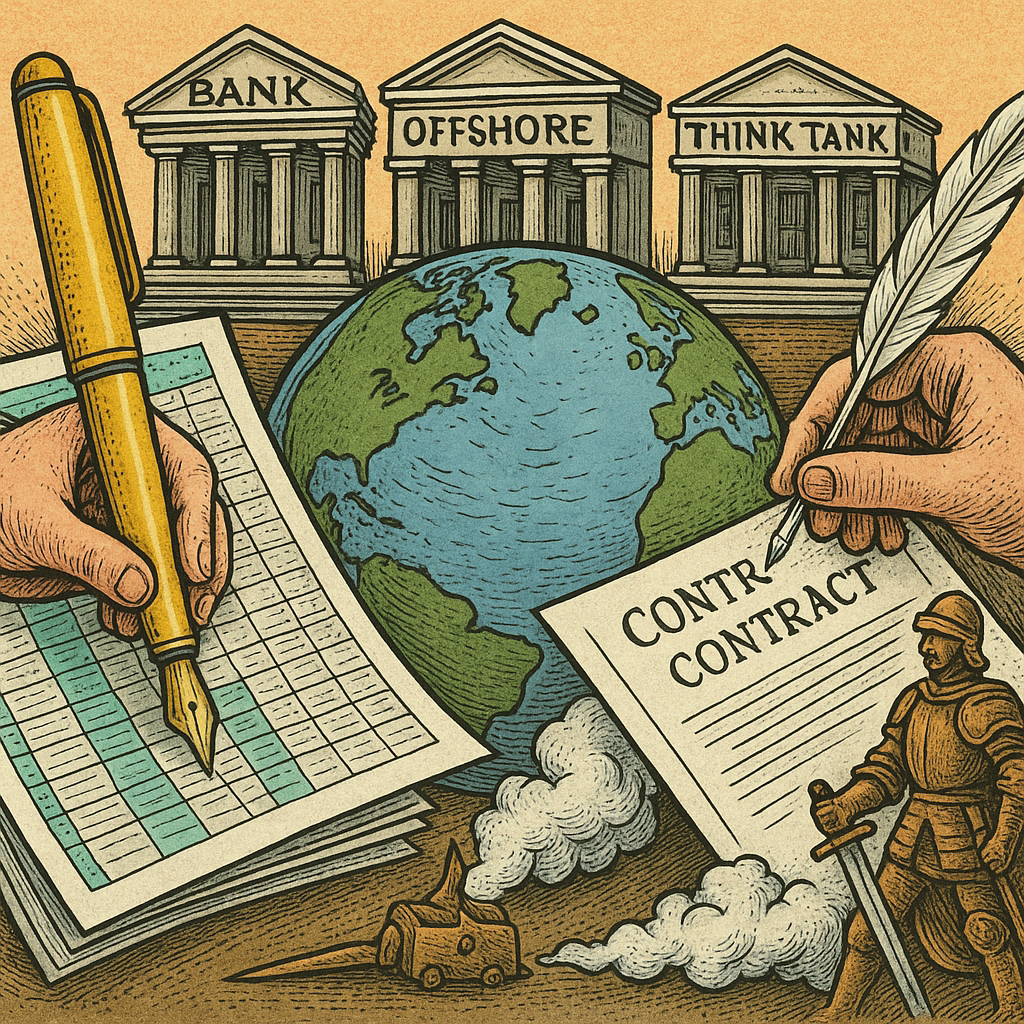
Control of capital flows, legal contracts, and offshore safe havens has replaced territorial conquest - the pen (and the spreadsheet) are mightier than the sword!








 [End]
[End]