Saturday, 28 June 2025

UKRAINE, THE EU AND THE BROKEN STAIRCASE TO EU MEMBERSHIP.

28 June 2025

Ukraine, the EU, and the Broken Staircase to Europe

1. The Promise That Sparked a Revolution

The 2014 Maidan uprising, known as "EuroMaidan," was driven by a single powerful belief: that Ukraine was on a path toward integration into the European Union. The EU Association Agreement, though technically limited to trade and legal convergence, was interpreted by many Ukrainians as a concrete first step toward eventual EU membership. When then-President Viktor Yanukovych suspended its ratification under pressure, mass protests erupted. The square Maidan filled, the flags waved, and eventually, the government fell. But the European dream remains unfulfilled.

2. A Long-Held Aspiration

While NATO membership was deeply divisive in Ukraine before 2014, EU membership was not. Polls showed consistent majority support for joining the EU. This aspiration was not merely bureaucratic, it was existential. Ukrainians wanted to live in a rule-based society, to travel freely, and to be anchored in a European future. EuroMaidan was as much a cry for dignity and direction as it was about paperwork and trade.

3. Russia's Objection: A Rational Trade Concern

Western narratives often paint Russia’s opposition to Ukraine’s EU Association Agreement as political meddling. But there is a crucial economic dimension that is often ignored.

At the time, Ukraine already had a free trade agreement with Russia under the CIS (Commonwealth of Independent States) framework. If Ukraine also entered into a deep trade agreement with the EU, then European goods could enter Ukraine tariff-free, and from there, be re-exported into Russiabypassing Russian import restrictions and duties.

In short: Russia risked losing control over its external trade policy, as Ukraine would become a conduit for EU goods. The arrangement would undermine Russian domestic producers while allowing European exporters backdoor access to the Russian market.

Ironically, when the EU and UK negotiated the Northern Ireland Protocol after Brexit, the EU used the exact same argument to protect its single market: that British goods could enter the EU via Northern Ireland unless strict customs controls were implemented. In this light, Russia’s objections to the EU-Ukraine deal appear not only understandable but identical to EU logic - the logic remains the same, but the EU flipped for political reasons.

4. The Conflict Begins

When Yanukovych tried to renegotiate the deal - proposing trilateral talks involving Russia - the EU refused. The EU deemed the Association Agreement non-negotiable and would not change "a single punctuation mark". That refusal - and the pressure it created - triggered the sequence of events that led to regime change (a coup supported by the CIA, according to many independent analysts), Crimea’s annexation, and eventually the war.

Many Ukrainians believed EU membership was within reach. The movement even took the name “EuroMaidan.” Websites, protest art, and banners bore the EU flag. And so when the war began, the hardship was endured under the belief that it was part of the price to “return to Europe.”

5. A Shattering Disillusionment

Now, as Brussels signals cold feet and the possibility of EU entry fades, the emotional toll may be immense. A broken promise on EU membership would not just be a diplomatic setback—it would be a psychological catastrophe for a population that endured immense suffering under the assumption that their sacrifices had meaning.

Yet current opinion polling though sparse and difficult to trust under martial law, suggests that many Ukrainians are exhausted. 72% reportedly support a ceasefire or freezing of the conflict, and only 16% favour continuing the war indefinitely. Enthusiasm for reclaiming all lost territory has waned.

Still, bitterness could erupt if EU membership is formally ruled out. It would signal that the entire Maidan movement - the hundreds of thousands of deaths, the war and devastation of Ukraine's built environment, the economic devastation - was in vain, all in vain. As one commentator noted, Ukrainians followed a staircase labelled "Europe"—and now find it leading nowhere.

6. Conclusion: The Illusion That Fueled the Fire

EU membership was never a guarantee. But it was treated as a moral contract, a shared dream between Ukraine and the EU. If that promise is broken, it may not spark another revolution, but it will deepen the sense of betrayal, trauma, and fatigue, already spreading through a shattered nation.


Tuesday, 24 June 2025

FALLOUT FROM AMERICA BOMBING IRAN'S URANIUM NUCLEAR FACILITIES.

24 June 2025

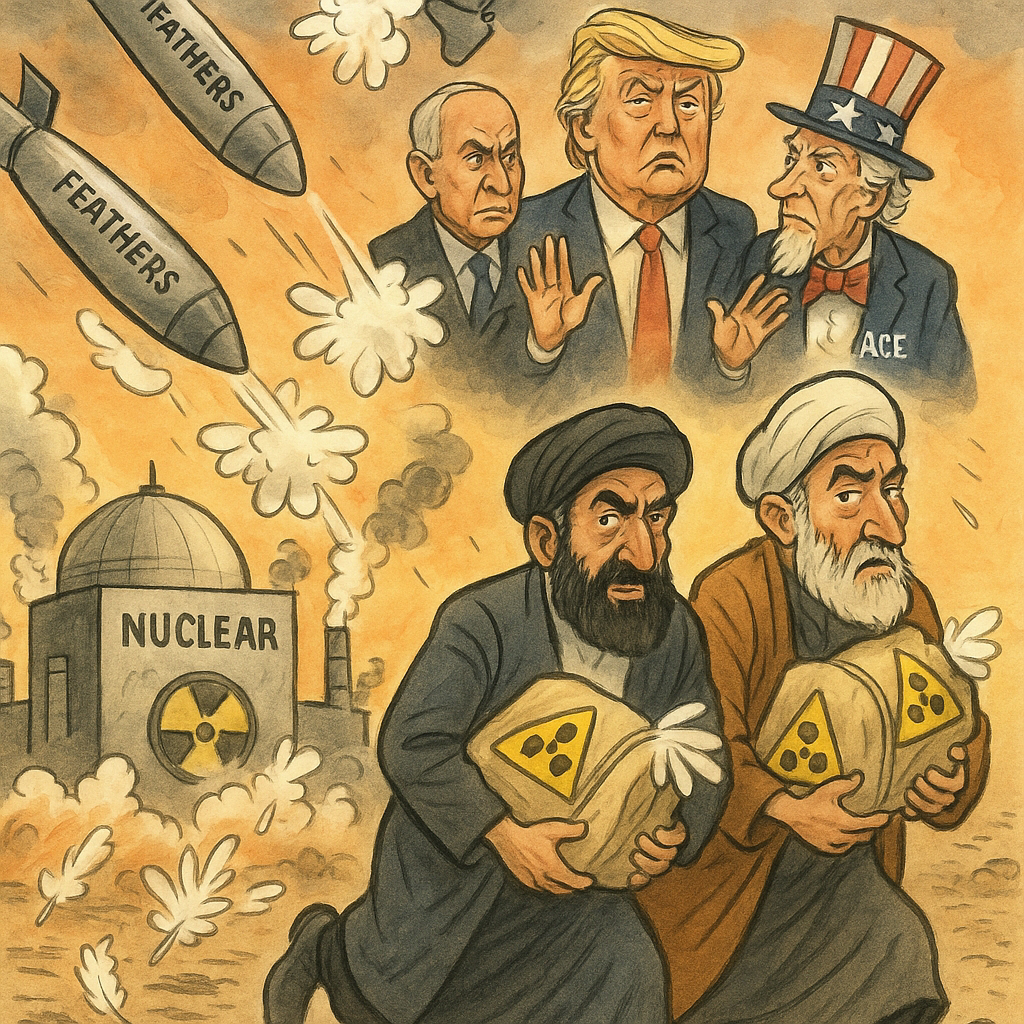
It was always a stupid idea to want to blow 400 kg of highly enriched uranium out of its safe bunkers, deep underground, up and out into the atmosphere and strewn across the surface of the planet, blown by the winds, hither and thither.

But even dumber was to imagine that the owners would not have taken steps to safeguard their little haul, because now, no one except a handful of highly trusted officials know where it is! It's gone walkies!!

Offers of help to find it must be pouring in, but I imagine the owners will accept offers from anyone able to quickly turn it into an atomic weapon.

Stupid is as stupid does.


Monday, 23 June 2025

TRUMP BOMBS IRAN'S TOP THREE NUCLEAR FACILITIES

23 June 2025

TRUMP BOMBS TOP THREE IRANIAN NUCLEAR FACILITIES


1. Has Trump Been Played by Israel? Or Is This High-Stakes Theatre?

The United States has now joined Israel in bombing Iranian nuclear sites, a step no previous U.S. president has taken. The question many are asking is: why? Has Trump allowed himself to be manipulated by Tel Aviv? Or is this calculated theatrics to appease allies and protect political capital?

Even from a MAGA vantage point, it’s hard to square recent events with constitutional or international legality, economic rationality, or geopolitical strategy. Can a U.S. president lawfully launch strikes without Congressional approval? Technically yes, under the War Powers Resolution, but only under certain conditions. Many would argue Trump is bypassing constitutional checks, behaving more like a monarch than an elected president.

2. The Oil Barrel Is the Canary in the Coal Mine

A good place to begin understanding this situation is with the price of oil. As of this writing, Brent crude is hovering around $70. But following Iran’s closure of the Strait of Hormuz in response to the U.S.-Israeli strikes, analysts expect prices to surge - potentially reaching $90 to $120 per barrel.

Why does this matter? Because energy is the lifeblood of industrial economies. A jump in oil prices raises production costs, triggers supply chain distortions, and fuels consumer inflation. That in turn leads to wage demands and tighter corporate margins. The classic recipe for a stagflationary spiral.

3. Recession Risk: The Clock is Ticking

A recession is defined as two consecutive quarters of negative GDP growth. Higher oil prices alone are enough to threaten this. Consumers cut back. Businesses pull back. And once demand slumps, investment dries up.

Normally, central banks respond by easing policy - cutting interest rates to stimulate borrowing and production. But that’s not so easy this time. The U.S. is approaching the final stages of an 80-year debt supercycle. Government debt now stands at 122% of GDP, and the fiscal deficit is running at 6–7% of GDP. To bridge that gap, Washington must borrow by issuing more Treasury bonds, or print.

4. The End of the Treasury Game?

Traditionally, countries like China have recycled their trade surpluses into U.S. assets: Treasuries, equities, and even real estate. This "vendor financing" model let's call it, kept U.S. interest rates low and asset markets booming.

But if the U.S. economy heads into recession and inflation rises, foreign buyers may accelerate dumping Treasuries, lowering demand for us Treasuries.. Lower demand means lower prices, which means higher yields, and thus a rising cost of debt for Washington.

Meanwhile, credit spreads (the difference between safe government borrowing and risky private-sector lending) are widening. This puts additional pressure on business margins and private investment.

5. The Fiscal Cliff: 20% to Debt, 100% to Welfare...and then some

Right now, 20% of federal tax receipts go to servicing debt, and mandatory welfare programmes consume 100% of all revenue. That leaves nothing for discretionary spending - defence, infrastructure, R&D - unless the government borrows even more.

And now there’s another war. Wars are expensive. Fuel prices surge. Global shipping is threatened. All this as the Fed faces an impossible choice.

6. The Fed’s Impossible Dilemma

The Federal Reserve is cornered:

Raise rates to attract bond investors? That would cool inflation but crash the economy.

Cut rates to avoid recession? That would spur inflation and collapse the dollar.

This war, if prolonged, could break the global economy’s back. The Strait of Hormuz is the choke point for 30% of global seaborne oil (mostly going to Europe incidentally, while America is self-sufficient in energy). A prolonged closure would ignite energy shocks not seen since the 1970s.

7. Is This War Real, or Just Political Theatre?

There’s another possibility: that the U.S. strike was more symbolic than strategic. Trump may have sought to placate Israel and burnish his own image as a defender of Western civilisation, while calculating that Iran’s response would be limited. There are various reports going around that through the usual Swiss back channels, Trump’s administration essentially informed Iran of the strikes, implying that as long as Iran does not respond it will be a ‘one-off’ attack

Early reports show that no radiation has been detected at the bombed nuclear sites. That suggests either the strikes were limited in scope, or perhaps the nuclear material was moved out, possibly to Russia or China. So no-war Trump could be appeasing the neocons in his camp.

If that’s so, there could be.a negotiated de-escalation, Iran reopening the Strait of Hormuz and no further strikes. The world can breathe again until next time....

8. Final Thoughts: The Edge of the Abyss

This crisis may yet pass. But if it doesn’t, if oil remains above $100, if Iran persists or retaliates unpredictably, if America is unwilling or unable to unblock the strait of Hormuz, if the Fed is forced into monetary acrobatics, if the conflict escalates... then we’re staring at a very dangerous convergence: war, recession, fiscal breakdown, currency instability, maybe worse....end of the nuclear proliferation treaty and of credibility the International Atomic Energy Authority, IAEA.... Perhaps iran will finally think about turning to developing a nuclear deterrent.

Trump may claim this is about making America great again. But when markets crash, inflation bites, and allies distance themselves, what exactly is being made great?

Saturday, 21 June 2025

ISRAEL'S ECONOMIC FRAGILITY

21 JUNE 2025


1. Israel Is Not One Economy

Israel’s economy is starkly divided: affluent tech hubs (Tel Aviv, Herzliya) versus peripheral, marginalized regions (Negev, Galilee, East Jerusalem).

Defence funding is heavily skewed to areas under threat.

Economic resilience varies sharply across regions and communities.

2. Fiscal Fragility in Wartime

Defence spending has surged, crowding out civilian investment.

War with Iran (2025), ongoing conflict in Gaza and Lebanon, and regional instability are accelerating deficits.

Fitch downgraded Israel's credit; Bank of Israel estimates war costs at ~$55 billion 2023 - 2025 .

3. Overpromising the Welfare State

Entitlements to pensions, veterans, settlers, and religious institutions remain rigid.

Wartime funding priorities clash with enduring welfare commitments.

Social support increasingly stretched amid inflation and economic slowdown

4. Volatile Tax Base and Growth Engine

Tech exports once buoyed revenue; now capital flight and declining receipts weigh heavily.

Consumer spending fell ~27%, exports ~18% post-Gaza war .

Revenue volatility undermines budget stability.

5. Undiversified Economic Exposure

Israel depends heavily on military tech and cyber exports.

Non-military sectors (tourism, agriculture) collapsed amid regional conflict.

Geopolitical tension isolates Israel from West Asia markets.

6. Demographic Shift & Strategic Emigration

Mass emigration: ~82,700 Israelis left in 2024; only 23,800 returned .

Departure surged ~285% after 7 October .

Nearly 60,000 left permanently in early 2024 (+59%) .

Young and skilled emigrants dominate: 81% under 45 .

This mirrors a brain drain, weakening Israel’s economic core .

7. Governance Dysfunction Amid Crises

Prolonged coalition instability peaked during 2023–2024 judicial reforms.

Political paralysis at critical moments (post October 7, war escalation) hinders recovery.

Leadership fixates on internal battles rather than national resilience.

8. Collapse of Confidence

The 7 October breach shattered confidence in national security .

International investors scaled back projects; millionaires fled ($1,700,000 lost in 2023) .

Israel's reputation fractured among allies and Sunni neighbours.

9. Case Studies: Gaza Border, Galilee, Settlements

Gaza border areas remain destroyed and depopulated.

Northern towns under missile threat suffer from business shutdowns.

Settlements drain resources and deepen foreign diplomatic isolation.

10. Diversification Blocked by Geopolitics

Regional war disrupts proposed export corridors to Gulf and Asia.

Opportunities in green energy, biotech, or manufacturing are frozen.

Israel’s West Asia positioning isolates it from economic peers.

11. Political Paralysis as a Risk Multiplier

Coalition-building revolves around ideologies, not reform.

Judicial tussles, settler politics, and religious influence block structural change.

In wartime, lack of cohesive long-term strategy worsens every other vulnerability

Glossary

Emigration / Yerida: The phenomenon of Israelis, particularly skilled youth, leaving the country permanently.

Fiscal fragility: Budgetary risk due to debt inflexibility or unforeseen obligations.

Brain drain: Outflow of educated and skilled individuals, weakening innovation and growth.

West Asia: The accurate geopolitical region encompassing Israel and its neighbouring states.

Conclusion

Israel’s economic resilience is crumbling under the combined weight of war, political dysfunction, and a mass exodus of its younger, skilled citizens. While Israel once glittered as a “Start‑Up Nation,” emigration now constitutes a critical vulnerability - draining human capital, shrinking the tax base, and threatening long-term growth. Positioned in a volatile West Asia, surrounded by hostility and isolated; Israel must urgently reform governance, diversify the economy, and reverse migration trends - or risk systemic decline.

Friday, 20 June 2025

RIO - ANALYSIS AT 20 JUNE 2025

1. 📊 Peer Comparison: RIO vs BHP & Vale

Metric / Company RIO Tinto (RIO.L) BHP Group (BHP.L) Vale SA (VALE)
Market Cap ~£110 bn ~£110 bn ~£35 bn
5-Year Stock Return +38 % over five years; ~57 % over ten years
Dividend Yield ~6.4 % (5-year avg) ~6.35 % ~7.6 %
P/E Ratio ~11.5× current; ~10× average ~12.1× current; ~13.3× FY23
Volatility Relative to RIO Highly correlated (~0.9 over 3 months) ~1.39× more volatile
Cash Flow & Debt Strong cash flow and lower net debt More debt but higher revenue

Key Takeaways:

  • RIO is competitively valued: Similar yield and P/E to BHP, with lower volatility than Vale.
  • Over the past decade, RIO has outperformed BHP, especially in total return.
  • Vale, while cheaper with a higher yield, carries greater volatility.

2. 📈 Historical Performance Under Macro Shifts

  • Similarity with peers: RIO’s stock trends closely mirror BHP and Vale, with a correlation of ~0.9.
  • Best performance periods:
    • 2016–2021: Commodity supercycle rebound drove RIO ~+90%.
    • During inflationary spikes: Mining equities tend to benefit, especially when rates are low and growth is steady.

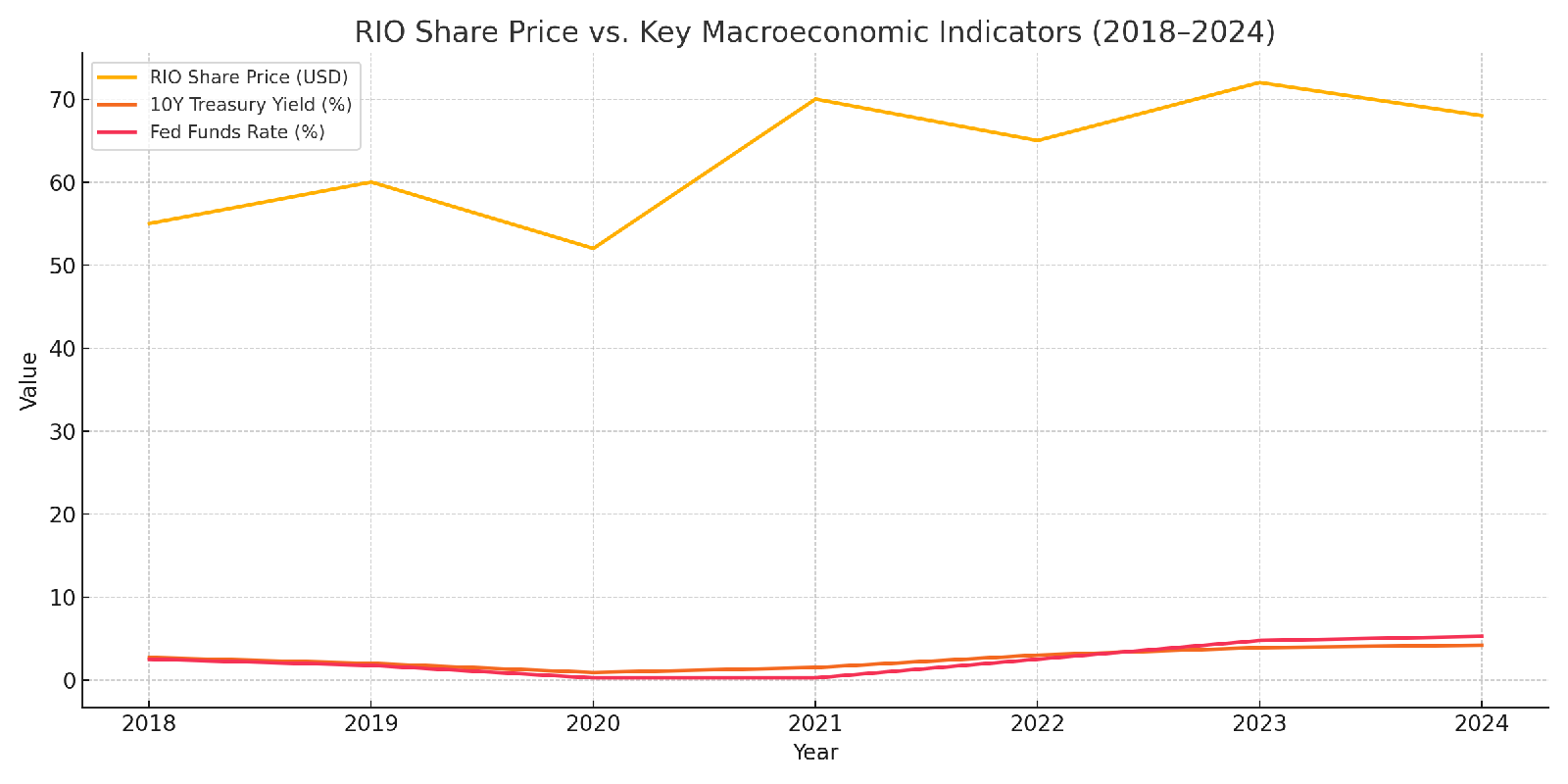
Visual Summary (imagine this charted):

  • X-axis: 2014–2025
  • Y-axis: Indexed (100 = 2014 start)
  • Plots: RIO, BHP, Vale
  • Vertical bars marking:
    • 2020–21 QE-inflation rebound (all three up 50–90%)
    • 2024 industrial slowdown (drop of 10–20%)

3. 🔍 What to Watch (Macro vs Company)

  • Commodity Prices: Iron ore, copper, aluminium — positive moves support RIO.
  • Chinese industrial signals: Slowdowns weaken miners.
  • Global M&A & consolidation: Activity may lift market sentiment.
  • Structural moves: United-listing debate (ASX/LSE) may impact investor demand.

✅ Bottom line

  • RIO is competitive: Similar valuation to BHP, less volatile than Vale, with consistently strong dividend income and historical outperformance.
  • Shares highly correlated with peers: It moves in sync with industry-wide shifts.
  • Macro factors matter most: Commodity prices and Chinese demand are the main drivers.
  • Outlook: If the Fed cuts rates and inflation remains modest, RIO is well placed to rebound; but a significant global slowdown would hit miners across the board.

Thursday, 12 June 2025

THE COLOUR REVOLUTIONS PLAYBOOK

12 June 2025

1. What Are Colour Revolutions?

Colour revolutions are non-violent protest movements, often backed by Western NGOs, that aim to overthrow authoritarian or corrupt governments — typically in post-Soviet or developing countries — through mass mobilisation, media campaigns, and symbolic colour branding.

They're usually presented as grassroots democratic uprisings, but are often accused of being geopolitical tools used to expand Western influence.

2. Why the Name "Colour"?

Each revolution is branded with a symbolic colour or flower — easy to rally around, good for headlines, and useful for international PR. Examples:

Serbia (2000): Bulldozer Revolution (no colour, but same playbook)

Georgia (2003): Rose Revolution

Ukraine (2004): Orange Revolution

Kyrgyzstan (2005): Tulip Revolution

Lebanon (2005): Cedar Revolution

Ukraine again (2014): Euromaidan (not a "colour" but same method)

3. The Basic Blueprint

1. Contested Election or Crisis
2. Mass protests erupt, often well-organised
3. Use of social media, NGOs, and youth movements (e.g. Serbia’s Otpor!)
4. Western diplomatic support, financial aid, or covert backing (via USAID, NED, Soros foundations)
5. The goal: regime change without military intervention

4. What Is the Purpose?

From a pro-Western perspective:
Promote democracy, civil society, human rights
Remove corrupt or authoritarian regimes
Align countries with Western economic and political structures (EU, NATO, IMF)
From a critical or anti-imperialist perspective:
Serve as tools of Western geopolitical engineering
Weaken Russian or Chinese regional influence
Install friendly, neoliberal governments willing to open markets and back Western security agendas
Often trigger instability or civil conflict (e.g. Ukraine 2014 → Crimea annexation, Donbas war)

5. Key Actors Behind the Scenes

National Endowment for Democracy (NED) – U.S. Congress-funded NGO that supports civil society and media
Open Society Foundations (Soros) – Funding for education, media, and legal reform
USAID – Official U.S. aid agency, often tied to soft power goals
CIA and Western intelligence – Alleged involvement in shaping the outcomes discreetly

6. Notable Consequences

Mixed results: Some revolutions led to democratic reforms, others to chaos or war
Russia and China now see colour revolutions as existential threats
Western support for such movements has contributed to global mistrust of NGOs and media
Colour revolutions laid groundwork for hybrid warfare, cyber ops, and info battles

7. Summary

Colour revolutions are branded mass uprisings, often backed by Western interests, that aim to topple regimes without tanks. Though framed as democratic awakenings, they are widely seen as tools of geopolitical power projection, with high stakes and long-term blowback.

Worked example of playbook

Here is a worked example of a Colour Revolution, using Ukraine’s 2004 Orange Revolution as a case study — a textbook example of the Colour Revolution playbook in action.

1. TIMELINE: THE ORANGE REVOLUTION (UKRAINE, 2004)

Background

Ukraine at the time was caught between two spheres of influence: Russia, which backed a pro-Kremlin elite, and the West, which backed EU/NATO-friendly factions.

Two key figures:

Viktor Yanukovych (pro-Russia, incumbent regime)

Viktor Yushchenko (pro-West opposition)


Step-by-Step Breakdown of the Colour Revolution Playbook:

1.1 Trigger: Contested Election

Presidential elections held in October–November 2004.
Yushchenko was poisoned with dioxin during the campaign, widely believed to be an assassination attempt.
Official results in November declared Yanukovych the winner, but allegations of electoral fraud quickly emerged.

1.2 Mass Mobilisation

Spontaneous-looking protests erupted in Kyiv’s Independence Square (Maidan Nezalezhnosti), with orange (Yushchenko’s campaign colour) as the unifying symbol.
Protesters camped out in the square for over two months in winter conditions.
Estimated turnout: hundreds of thousands in Kyiv, with protests spreading across the country.

1.3 Branding and Narrative Control

The term “Orange Revolution” was quickly picked up by Western media, NGOs, and political commentators.
The movement used slogans, coloured clothing, and youth energy — much like Serbia’s Otpor! four years earlier.
Western-funded media like Channel 5 Ukraine promoted the protest narrative.

1.4 NGO and Western Support

Funding and support flowed through:

National Endowment for Democracy (NED)
George Soros’s Open Society Institute
USAID

Western embassies provided logistical support, training, and advisory services to opposition campaigners.
Alleged involvement of foreign political consultants (e.g. from the U.S. Republican and Democratic parties).

1.5 Elite Defection

Key members of Ukraine’s security services and business elite refused to crack down on protesters.
Portions of the military and judiciary shifted loyalty or remained neutral.

1.6 Outcome: Regime Change via Legal Reversal

The Ukrainian Supreme Court annulled the election results in December 2004.
A re-run of the vote was ordered.
Viktor Yushchenko won the re-run and was inaugurated as president in January 2005.

2. Geopolitical Results

For the West:

Huge soft power win. Ukraine appeared to pivot toward EU and NATO alignment.
Served as proof-of-concept for peaceful regime change without direct military intervention.

For Russia:

Strategic loss. Putin viewed the revolution as a Western coup in his backyard.
Moscow began developing counter-revolution strategies: information warfare, energy leverage, intelligence activity.

3. Legacy of the Orange Revolution

By 2010, Yushchenko’s coalition fell apart. Yanukovych returned to power — democratically — before being overthrown again in the 2014 Euromaidan uprising, a kind of Colour Revolution 2.0, this time with open Western diplomatic presence and violent escalation.
The Orange Revolution became the playbook template used in Georgia, Kyrgyzstan, Lebanon, and attempted in Belarus, Hong Kong, and elsewhere.

4. Summary

The Orange Revolution followed the Colour Revolution blueprint: a disputed election, coordinated mass protests, NGO/media support, elite defections, and a regime change — all under the veneer of democratic mobilisation, but backed by deep geopolitical interests from both East and West.

Here's another : Belarus

And here is the process itself, the "playbook"

Here is a process-driven view of how a Colour Revolution typically unfolds - a neutral analysis of the playbook at rhe tactical or operational level. This framework has been repeated, with variations, from Serbia to Georgia, Ukraine, Lebanon, Belarus, and beyond.

1. The Colour Revolution Playbook: Process View

Step 1: Identify the Target Regime

Choose an authoritarian, corrupt, or unpopular government.
Best results in semi-authoritarian states with weak institutions, some media pluralism, and contested elections.
Bonus if the regime is aligned with a geopolitical rival (e.g. Russia, China, Iran).

Step 2: Prepare Civil Society Infrastructure

Build or support local NGOs, student movements, media outlets, and legal aid groups.
Secure external funding (e.g. from Open Society Foundations, NED, USAID).
Conduct training in non-violent resistance, information warfare, and election monitoring.

Step 3: Wait for a Trigger

Triggers include:

Disputed election
Police violence
Corruption scandal
Economic collapse

Ideal trigger = rigged vote → emotional legitimacy for protest.

Step 4: Brand the Movement

Choose a unifying symbol (colour, flower, or flag).
Keep the branding simple, visible, emotional: e.g. orange, rose, tulip, red-white flag.
Launch slogans, social media hashtags, and PR campaigns to own the narrative.

Step 5: Mass Mobilisation

Coordinate mass protests, strikes, sit-ins, and student actions.
Occupy symbolic space (e.g. main square, parliament building).
Ensure optics: peaceful crowds, dramatic visuals, women and youth leadership.
Use smartphones, livestreams, and social media to bypass state media.

Step 6: Seek International Attention

Appeal to Western media, EU, UN, and international NGOs.
Leak videos of regime violence to inflame global opinion.
Frame the movement as pro-democracy, human rights-based.
Pressure foreign governments to issue sanctions or withhold recognition of election results.

Step 7: Trigger Elite Defection

Persuade sections of the elite to switch sides:
Security services
Judiciary
Business oligarchs

Use backdoor diplomacy, threats of sanctions, or promises of post-transition power.

Step 8: Force Regime Crisis or Negotiation

The regime cracks internally or is forced into negotiating transition (new elections, resignations, etc.)
If violent crackdown fails to stop momentum, the regime may collapse from within.

Step 9: Transition Phase

Install interim or opposition-backed government.
Write new constitution, reform media laws, pursue “transitional justice.”
Integrate the country into Western political and economic structures (EU/NATO/IMF).

2. Summary

A Colour Revolution follows a fairly standard script: build soft power infrastructure, wait for a crisis, mobilise symbolically, and escalate until the regime fractures — all under the banner of democracy, but often with external interests quietly at play.

Goals, desired outcomes, strategy programmes of work. The process

That structure makes perfect sense. Here's a comprehensive process map for executing a Colour Revolution, starting with the Goals, then Desired Outcomes, followed by Strategy for best use of resources, and finally the detailed Programmes of Work (Playbook).

1. GOALS TO BE ACHIEVED
(What the revolution seeks, overtly or covertly)

  • Regime change: Remove an authoritarian or unfriendly government
  • Democratic façade: Install a government legitimised through elections
  • Geopolitical realignment: Shift the country toward Western spheres of influence (EU, NATO, IMF)
  • Privatisation and market reforms: Create conditions favourable to Western investment
  • Civic mobilisation: Energise youth and civil society in support of “modernisation”
  • Media narrative control: Win the global PR battle by owning the definition of events

2. DESIRED OUTCOMES
(Indicators of success or transition)

  • Incumbent president or ruling party resigns, flees, or loses re-run
  • A pro-Western opposition figure takes power via election or accord
  • New constitution or legal reforms reflecting liberal-democratic norms
  • The country accepts Western financial and security integration
  • International institutions recognise the new government
  • The old regime is discredited or prosecuted, erasing its future power bas

3. STRATEGY OVERVIEW
(The model guiding action)

  • Soft power before hard power: Change is achieved via influence, not invasion
  • Symbolic legitimacy: Use elections, mass protests, and colour branding to construct a “popular uprising”
  • Hybrid operations: Combine legal civil action with covert support, tech disruption, and international pressure
  • Pressure from below, fracture from above: Stir mass discontent to trigger elite defections
  • Timing is everything: Strike when institutions are weak, elections are contested, and legitimacy is brittle

4. PROGRAMMES OF WORK (The Playbook)
(Tactical implementation – what to do and in what order)

4.1 Pre-Crisis Preparation

  • Build and fund civil society infrastructure (NGOs, think tanks, youth groups)
  • Support independent media and digital influencers
  • Conduct training in protest strategy, cyber-activism, and legal protection
  • Establish foreign donor channels (NED, Soros, USAID, EU delegations)

4.2 Mobilisation and Trigger Exploitation

  • Wait for or manufacture a trigger event: rigged election, police brutality, corruption leak
  • Mobilise the base: students, middle class, cultural elites
  • Launch non-violent protests in urban centres and symbolic locations
  • Ensure strong visual branding: flags, flowers, colours, slogans
  • Use viral media, livestreams, and English-language posts to globalise the message

4.3 International Narrative and Pressure

  • Activate foreign media and diplomats to condemn the regime
  • Document regime abuses and push for international sanctions
  • Lobby the EU, UN, and U.S. Congress for statements of support
  • Arrange high-profile visits by Western politicians or NGOs

4.4 Escalation and Elite Fracture

  • Sustain protests with rotating demonstrations and hunger strikes
  • Apply pressure to the judiciary and military to “do the right thing”
  • Expose regime divisions (leaked tapes, defector interviews)
  • Encourage business and oligarch classes to cut support for the regime

4.5 Transition Negotiation or Collapse

  • Push for election re-run, resignation, or transitional government
  • Fill power vacuum with trained opposition figures
  • Create a Truth and Reconciliation framework to isolate old regime
  • Enshrine Western-aligned policies in the new legal structure

4.6 Consolidation Phase

  • Invite IMF, EU, NATO officials to formalise partnerships
  • Purge regime loyalists from courts, media, and universities
  • Rebrand the nation with global campaigns (“New Ukraine”, “Democratic Georgia”)
  • Begin long-term monitoring and influence through embedded NGOs and trade deals

5. Summary

A Colour Revolution is not just a protest — it’s a systematic campaign of regime disruption, driven by clear goals, defined outcomes, a hybrid strategic doctrine, and a coordinated set of programmes. It uses symbolism and street energy as cover for deeper political realignment, always timed for maximum geopolitical leverage.


References

https://www.livingintheair.org/?m=1


[End]

Monday, 9 June 2025

AI CAREERS

9 June 2025

 AI Careers

(Salary ranges, career paths - to be added)


1.    Job Title: AI Prompt Engineer

Overview:
As an AI Prompt Engineer, you will design, test, and refine prompts to improve the performance of AI language models. This role sits at the intersection of software engineering, linguistics, and user experience.

Key Responsibilities:

  • Craft and iterate on high-quality prompts for AI models.
  • Analyse model outputs to refine instructions.
  • Collaborate with developers and product teams to implement prompt-based solutions.

Required Skills:

  • Strong communication and analytical thinking.
  • Familiarity with LLM behaviour (e.g., GPT-4, Claude).
  • Basic programming knowledge (e.g., Python, APIs).


2.    Job Title: AI Developer Advocate

Overview:
The AI Developer Advocate bridges the gap between AI tool creators and the developer community. You’ll help others build smarter tools with AI by writing content, hosting tutorials, and gathering feedback.

Key Responsibilities:

  • Educate developers on how to integrate AI tools.
  • Create demos, sample code, and blog posts.
  • Represent the company at meetups and conferences.

Required Skills:

  • Strong public speaking and writing skills.
  • Deep understanding of developer workflows.
  • Experience with modern AI libraries and APIs.


3.    Job Title: AI Integration Engineer

Overview:
This role focuses on embedding AI tools into existing business systems. As an AI Integration Engineer, you’ll ensure smooth, secure, and scalable implementation of AI functionalities in real-world applications.

Key Responsibilities:

  • Integrate APIs from AI providers into enterprise apps.
  • Monitor performance and error handling.
  • Collaborate with cross-functional teams to improve system architecture.

Required Skills:

  • Backend software development (Python, Java, Node.js).
  • Understanding of API protocols and data handling.
  • Cloud deployment and version control systems.


4.    Job Title: AI Solutions Designer

Overview:
As an AI Solutions Designer, you’ll map business problems to AI use cases and design human-in-the-loop workflows. You combine technical acumen with strategic thinking.

Key Responsibilities:

  • Work with clients to scope AI projects.
  • Design system architecture and user journeys.
  • Define evaluation metrics and testing scenarios.

Required Skills:

  • UX/UI awareness.
  • Strategic consulting or product design experience.
  • High-level understanding of AI capabilities.


5.    Job Title: AI Test & QA Analyst

Overview:
This role ensures AI tools work reliably and ethically. You'll test systems for accuracy, fairness, and performance across different scenarios.

Key Responsibilities:

  • Test prompt reliability and LLM outputs.
  • Conduct edge-case scenario analysis.
  • Build test suites and simulate user inputs.

Required Skills:

  • QA methodologies.
  • Familiarity with prompt tuning and LLM limits.
  • Documentation and reporting skills.


6.    Job Title: AI Technical Writer

Overview:
You translate complex AI systems into clear, useful documentation. You’ll work alongside developers and product teams to produce user guides, API docs, and onboarding material.

Key Responsibilities:

  • Write and maintain technical documentation.
  • Organise help centres and chatbot documentation.
  • Ensure clarity, consistency, and accuracy.

Required Skills:

  • Strong writing and editing skills.
  • Technical background or ability to grasp complex systems.
  • Familiarity with markdown, API tooling, and diagrams.
 

Update

Updated Job Descriptions for Emerging AI Roles in 2025

(Post-Prompt Engineering Era - prompt engineering was a stepping Stone in to AI. A couple of years ago, but now anyone who can type is expected to be able to write prompts, it's been operationalized, has become just a part of our daily lives, whether you are an office worker or an individual)


7. Job Title: AI Trainer

Overview:

An AI Trainer develops, tests and refines AI behaviour, ensuring natural, useful, and contextually appropriate responses in conversation-based systems. You’ll play a critical role in improving chatbot understanding, tone, and alignment with user intent.

Key Responsibilities:

Design realistic and varied user interaction scenarios.

Fine-tune chatbot behaviour based on user feedback and performance logs.

Create annotated datasets to improve model alignment.

Collaborate with data scientists and NLP engineers to deploy updated models.


Required Skills:

Linguistic awareness and UX sensitivity.

Familiarity with AI training pipelines and prompt tuning.

Ability to detect bias, hallucinations, or misalignment in model outputs.


Ideal Background:

Former content creators, UX writers, linguists, or prompt engineers transitioning to model behaviour design.


---

8. Job Title: AI Data Specialist

Overview:

The AI Data Specialist ensures AI models are trained on clean, relevant, and well-structured data. You will be responsible for preparing datasets, enforcing data governance, and continuously auditing data pipelines for quality.

Key Responsibilities:

Clean and structure large datasets for model consumption.

Detect anomalies, duplicates, or corrupted entries in training sets.

Collaborate with AI trainers and engineers to ensure data quality and relevance.

Maintain documentation and lineage tracking for data assets.

Required Skills:

Experience with SQL, Python (Pandas), and data labelling tools.

Understanding of machine learning model data needs.

Strong attention to detail, with an eye for statistical anomalies.


Ideal Background:

Data analysts or engineers pivoting into AI infrastructure support.


9. Job Title: AI Security Specialist

Overview:

As an AI Security Specialist, you’ll safeguard AI systems from evolving threats such as prompt injection, data poisoning, and adversarial attacks. You will work at the cutting edge of cybersecurity and machine learning.

Key Responsibilities:

Conduct vulnerability assessments on AI systems.

Design defences against prompt manipulation and misuse.

Ensure safe deployment of models within enterprise environments.

Monitor for suspicious access, misuse patterns, and insider threats.


Required Skills:

Strong grounding in cybersecurity principles and threat modelling.

Familiarity with LLM architecture, sandboxing, and red teaming techniques.

Knowledge of privacy-preserving AI techniques (e.g. differential privacy).


Ideal Background:

Cybersecurity professionals with interest in emerging AI threats; or ML engineers upskilling in security.